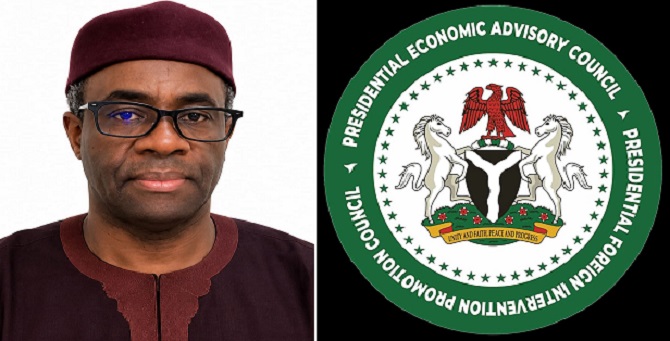
- Assures no kobo lost, no funds disbursed
- Says Budget Office ready with complete archive of materials
BY COBHAM NSA – Amid growing intense public scrutiny over the colossal ₦1,302,978,783.00 allocation for the Presidential Economic Advisory Council (PEAC) and Presidential Foreign Intervention Promotion Council (PFIPC), the Budget Office of the Federation (BOF) says there is no cause for alarm as not a single kobo was lost or disbursed from the massive funds quietly earmarked for the two ‘phony’ presidential councils in the 2026 budget.
Officially confirming that the appropriated funds were untouched, the Budget Office said with strict financial controls holding firm, zero public cash leaked from the controversial ₦1.303 billion budget allocation because the entire package remained securely locked in government coffers.
In a definitive verdict shutting down fears of any financial loss and flipping the script on rumours circulating about malfeasance, the Director General, BoF, Dr. Tanimu Yakubu, said in a statement issued on Friday, that a figure appearing in an Appropriation Act is merely the starting point of a regulatory process and does not automatically authorize the movement of funds, explaining that public money moves only when strict statutory conditions are met, including administrative clearances, legal recruitment, payroll verification, Treasury warrants, cash backing, and procurement approvals.
According to him, there are multi-agency structures governing federal finances and no single institution holds the power to convert an appropriation into expenditure on its own, adding that, “Between appropriation and expenditure lies a chain of controls, with each link assigned to a different institution.
“The Budget Office is one part of that chain. The Office of the Head of the Civil Service of the Federation approves establishment and recruitment. The National Salaries, Incomes and Wages Commission regulates remuneration. The Federal Ministry of Finance and the Office of the Accountant-General of the Federation control warrants, releases, cash backing and payment. The procurement authorities govern capital spending. No one institution can carry public money from appropriation to expenditure. Each control must hold before the next stage can open.”
Clearly turning a potential economic scandal into a high-stakes standoff over federal spending transparency, the Budget Office further explained that PEAC/PFIPC entered the 2026 budget following its origin under the administration of the late President Muhammadu Buhari, noting that before the budget preparation begins, the Office of the Accountant-General of the Federation (OAGF) usually assigned an administrative code, while the Office of the Head of the Civil Service of the Federation (OHCSF) is to grant an authorized establishment and recruitment waiver.
Offering further insight, the statement said when the Council submitted a personnel cost estimate of ₦3,850,935,000.00, the Budget Office rejected the figure and applied standard public-service costing methodologies to independently recalculate the allocation down to ₦802,978,783.00, which was subsequently submitted to Parliament, noting that the ₦802.97 million personnel provision, representing 61.63 per cent of the total budget, remained locked because required statutory milestones were never reached.
Noting that with the 2026 Appropriation Bill receiving Presidential Assent on March 31, 2026, which made prior financial clearance impossible, the National Salaries, Incomes and Wages Commission (NSIWC) had not yet verified that the Council’s proposed salary arrangements complied with approved public-service compensation frameworks.
Also detailing how each of the three appropriated components -personnel, overhead, and capital, stalled at different stages of the expenditure chain, the Budget Office said Personnel cost of N802, 978, 783.00, representing 61.63 percent of the total budget, never received financial clearance and as the 2026 Appropriation Bill was not signed into law until 31 March 2026, the National Salaries, Incomes and Wages Commission did not confirmed compliance with its remuneration template. so, no clearance meant no recruitment, no payroll enrolment, and no salary payments.
On the overhead cost of N200,000,000.00, representing 15.35 percent of the allocation, the statement said: “It was not payable as one annual sum. Overhead is released month by month after assent, and only when the Treasury issues the required warrant and provides cash backing. The annual figure translated to ₦16,666,666.67 a month. During the period under review, the Treasury generally released between 25 per cent and 50 per cent of monthly provision. The amount that might have become available therefore ranged between ₦4,166,666.67 and ₦8,333,333.33 a month. Even that depended on the cash position of the Government”.
However, in June 2026, after doubts emerged over the Council’s legal status, the Budget Office formally instructed the Ministry of Finance and the Accountant-General’s Office to withhold all payment instruments, closing off any release.
Similarly, the statement explained that capital expenditure of N300,000,000.00, representing 23.02 percent of the budget, intended as start-up funding for operational assets, required a procurement plan, Ministerial Tender Board action, and, where applicable, a Bureau of Public Procurement Certificate of No Objection, noting that the expenditure must ultimately be warranted, released and cash-backed. But none of these steps occurred.
The BOF boss said the safeguard lies in Nigeria’s institutional division of responsibility, where the Budget Office, the Ministry of Finance, the Accountant-General’s Office, the Head of Civil Service, and procurement authorities, each control a different link in the chain from appropriation to expenditure, emphasizing that: “No one institution can carry public money from appropriation to expenditure.”
Maintaining that the episode demonstrates the strength of Nigeria’s institutional financial controls in preventing financial loss, the Budget Office said tight expenditure controls succeeded as statutory safeguards blocked cash release and halted spending paths, adding that by withholding clearance, the final financial sign-offs were frozen before any funds could move.
“The system did not chase a loss. It prevented one,” the statement said, framing the episode as evidence of the resilience, not the weakness, of Nigeria’s public finance controls.
This is as the BOF expressed its resolve to fully support all legal investigations by openly sharing every necessary document, including detailed records, math computations, official messages, and digital system logs, adding that its open-door policy engagement with all legally authorized investigative bodies will not be tainted in the ongoing process.