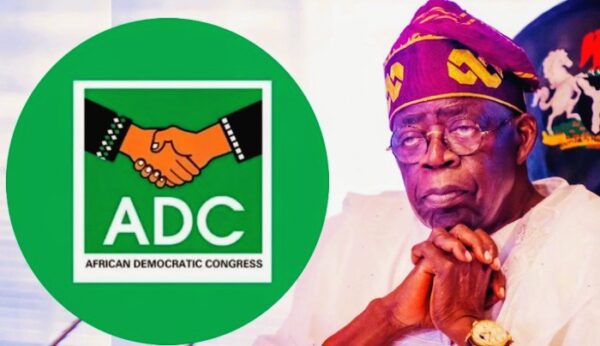
African Democratic Congress (ADC) has questioned how the reported N6.4 trillion savings from the removal of fuel subsidy are being utilised by the President Bola Ahmed Tinubu-led federal Government.
This is as the opposition party declared that the All Progressives Congress (APC’s) claim that the hardship being experienced by Nigerians is temporary, does not in any material particular align with available data.
The ADC pointedly said that surveys show that many Nigerians have gone without essential needs over the past year, adding that recent surveys showed that 82 percent of Nigerians report going without enough food at least once in the past year.
These were contained in a statement by Mallam Bolaji Abdullahi, National Publicity Secretary of the ADC in which he stated that 82 per cent of Nigerians have gone without medical care while 79 per cent are without cooking fuel just as 74 per cent have no clean water and 95 per cent without a cash income at some point during the year.
Abdullahi, who reeled out these figures while responding to criticisms from the All Progressives Congress (APC) on Sunday, March 15, 2026, accusing the ADC of inciting Nigerians through its comments on the economic reforms introduced by the Tinubu administration, emphasised that increase in fuel prices has pushed up transportation costs and food prices.
According to Abdullahi; “Petrol prices have increased by nearly 500 percent since President Bola Tinubu assumed office.
“88 percent of Nigerians describe the national economy as “bad”, while 74 percent say their personal living conditions are “poor”. These are not opposition talking points. They are the views of Nigerians themselves, APC members included.
“Nigerians are therefore left to ask a simple question: if the subsidy savings are truly being redirected to critical sectors, where exactly is all the money going? Why are local contractors not paid? Why are the universities still poorly equipped?” Abdullahi asked.
The ADC specifically said it only highlighted available data on the economic situation in the country, adding that reports indicated that Nigeria’s poverty rate has risen to 63 percent from about 50 percent before the removal of the petrol subsidy.
Abdullahi noted that the figures reflect the human cost of the administration’s economic policies, saying that independent surveys clearly show that many Nigerians believe the country is moving in the wrong direction.
He further said; “The independent report that triggered this debate shows that Nigeria’s poverty rate has risen to 63 per cent, up from about 50 per cent before the removal of petrol subsidy”.
Abdullahi further said that millions of Nigerians have been pushed into poverty since the reforms were introduced, adding that the surveys indicated that 93 per cent of Nigerians believe the country is heading in the wrong direction.
Abdullahi also raised concerns over developments in the agricultural sector, stressing that reports indicate that nearly 90 rice mills in Nigeria have shut down while many others are operating below capacity.
The ADC further said; “Data from the National Bureau of Statistics shows that Nigeria’s food import bill has increased significantly. The food import bill rose from N3.83 trillion in 2023 to N7.65 trillion.
“Economic reforms should be judged by their impact on citizens. When poverty rises from 50 per cent to 63 per cent, when nine out of 10 Nigerians say the country is on the wrong path, and when millions struggle to afford basic necessities, it is clear that something is fundamentally wrong,” the statement stated.
The ADC said that Nigerians expect policies that improve their living conditions, stressing that the gap between official claims and the realities faced by citizens will widen if the government fails to prioritise their welfare.