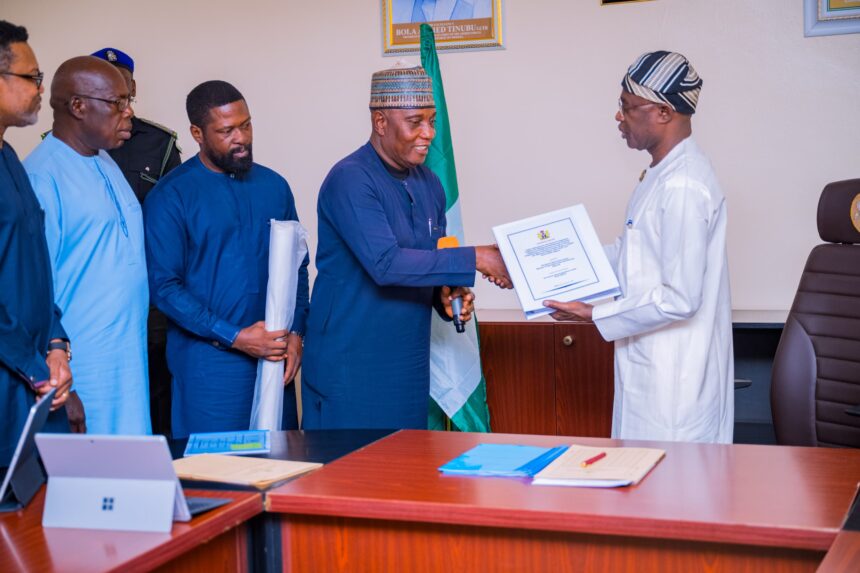
The Governor of Benue State, Rev. Fr. Hyacinth Alia has said that the Memorandum of Understanding (MoU) on AGROBENUE Industrial Development (ABID), marks a significant milestone in the state’s journey towards sustainable agricultural transformation and economic prosperity.
Gov Alia, who stated this on Monday, at Government House during the signing of the MOU with the AGROBENUE team led by Prince Henry Erimodafe and the Isu Remote Sensing and Algorithm Team led by Prof. Badaru Usman, said that Benue State has long been known as the Food Basket of the nation.
He said that his administration recognizes that the future of agriculture lies not only in production, but in value addition, processing, industrialization and market expansion.
According to Alia; “It is therefore the policy direction of this administration to transform agriculture from subsistence farming into a modern, commercial, and industrial sector that will drive economic growth, create employment, and enhance food security”.
The Governor said that the proposed investment of approximately $530 million in an integrated agro-industrial estate represents a major boost to the administration’s development strategy, adding that the MoU signing was not merely a ceremonial exercise, but a strategic step in implementing the administration’s agricultural development agenda.
He said; “Our vision is to position Benue State as a leading agro-industrial hub in Nigeria and West Africa, where agricultural products are processed, packaged, and exported with global standards.
“This project aligns directly with the key pillars of our administration, particularly in economic revitalization, agricultural transformation, youth empowerment, and sustainable development”.
Alia said that agriculture remains the backbone of the Benue economy, adding that the prosperity of the rural communities depends largely on the productivity and value of what the farmers produce.
“Through this partnership, we are moving beyond traditional farming methods to establish a complete agricultural value chain from production to processing, storage, logistics, and market access.
“The benefits of this initiative will be far-reaching. The establishment of this agro-industrial estate will generate employment opportunities across multiple sectors, including agriculture, processing, logistics, warehousing, transportation, equipment maintenance, and administration.
“Thousands of our youths will gain meaningful employment, while many local businesses will benefit from expanded supply chains and service opportunities.
“Our farmers produce yam, cassava, grains, soybeans, rice, and several other crops in large quantities. Yet much of this product leaves our state without value addition. With modern processing facilities, these crops will be transformed into higher-value products such as starch, flour, and other industrial inputs. This will significantly increase farmers’ incomes while strengthening the local economy,” he said.
The Governor noted that one of the major challenges facing agricultural systems in Nigeria is the high level of post-harvest losses due to inadequate storage and processing infrastructure, emphasising that by investing in modern storage facilities, cold chains, and logistics systems, the State will reduce wastage, stabilize food supply, and improve affordability for the people.
He further said; “With improved quality assurance, certification, and efficient logistics systems, Benue will be better positioned to compete in regional and international markets. This will attract further investment and reinforce our reputation as a leader in agro-industrial development.
Governor Alia assured that with the increase in industrial activities, the formal economy will grow through new businesses, employment opportunities, and expanded commercial activities.
He also said that the development will strengthen government revenue and enable further investments in critical sectors such as education, healthcare, infrastructure, and security.
In the words of Alia; “I am particularly pleased to note that the land survey for the project has already been completed, and the necessary documentation is available. This represents an important technical milestone and demonstrates our commitment to ensuring that this project moves forward on a solid foundation.
“The MoU establishes a Steering and Technical Committee involving key stakeholders and agencies, including Lands, Justice, Agriculture, and other relevant institutions. This committee will work closely with our partners to ensure smooth implementation, timely approvals and transparent reporting as the project progresses.
“In the coming weeks and months, the focus will be on completing the necessary technical and legal processes that will enable the project to move rapidly into its implementation of phase 1. Our administration remains fully committed to providing the enabling environment required for this investment to succeed,” the Governor assured.