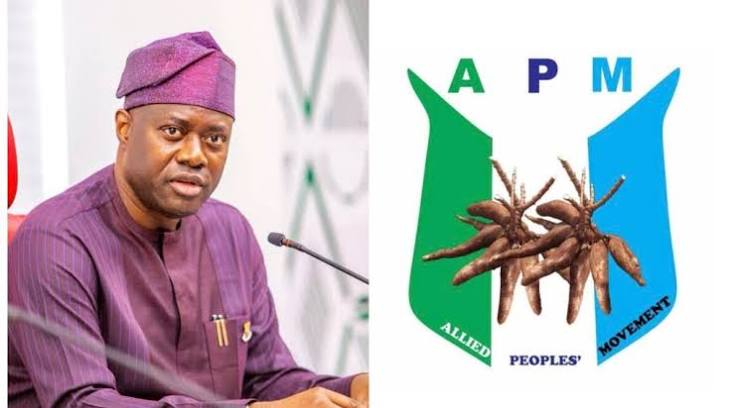
The Allied Peoples Movement (APM), and its presidential candidate, Governor Seyi Makinde of Oyo State, have sued Governor Alex Otti of Abia and others over alleged unlawful imposition of N200 million mandatory campaign fee on presidential candidates wishing to have his or her campaign materials displayed in any part of the state.
The APM and Makinde in the suit filed through their lawyer, Musibau Adetunbi, SAN, argued that by virtue of Sections 1(3) and 4(5) of the 1999 Constitution, any State law, public directive, or administrative regulation that is inconsistent with an Act of the National Assembly (the Electoral Act 2026) is null, void, and of no legal effect to the extent of its inconsistency.
The plaintiffs stressed that unless the court swiftly intervenes to declare the imposed fee illegal and restrain the defendants, the APM’s presidential candidate will suffer irreparable harm to his constitutional right to seek public office, and the democratic principle of a level playing field will be severely compromised.
They particularly faulted the fee, arguing that the action violates the 1999 Constitution, the Electoral Act, 2026 and other relevant laws.
In the suit with number HC/214/2026, was filed at the High Court of Abia State, the plaintiffs said they learnt about the fee while preparing to commence their nationwide campaign, stressing that if every state was to impose such a huge fee, it would be impossible for any presidential candidate to abide by the campaign funding limit imposed by the Electoral Act 2026.
Listed along with Governor Otti as defendants in the suit are the state’s Attorney General, Abia State Signage and Advertisement Agency (ABSAA), and the State House of Assembly.
The plaintiffs specifically raised six questions for determination by the court and also prayed for eight reliefs, including an order setting aside the regulations made by the Abia State Signage and Advertisement Agency (ASAA) in respect of political campaigns, including the imposition of campaign fee of N200m on presidential candidates or any amount.
The APM and Makinde urged the court for an order of injunction restraining the defendants and their agents from enforcing the campaign or signage fee and from removing, defacing, destroying and obstructing the placement of the complaints’ political campaign billboard and outdoor advertisements within Abia State.
The plaintiffs are also seeking a declaration that by the combined operation of Item F Section 15(a) and (f) of the Third Schedule of the Constitution, Sections 92 and 99 of the Electoral Act, 2026 and sections 1(3) and 4(5) of the Constitution, the imposed campaign fee schedule of N200,000,000 by the ASAA is inconsistent with federal legislation, unconstitutional, and null, and void ab initio.
The APM and Makinde want a declaration that by the provision of Section 99(2) of the Electoral Act, 2026, ASAA’s imposition of N200m as campaign fee for presidential candidates in order to display campaign materials in Abia State’s advertising space is in contravention of the Electoral Act, 2026, which prohibits the employment of state’s apparatus or regulatory bodies to the advantage or disadvantage of any political party or candidate at an election and also contravenes the principle of level playing field for all contestants and political parties.
While justifying the need for the suit, the plaintiffs stated that by virtue of Item F, Section 15(a)and(f) of the Third Schedule of the 1999 Constitution (as amended) and Section 9(1) of the Electoral Act, 2026, INEC is the body exclusively vested with the power to make rules and regulations in respect of political campaigns for the candidates and political parties for the purpose of elections.
The APM and Makinde stressed that Section 99(2) of the Electoral Act 2026 strictly forbids using state apparatus, including administrative bodies, regulatory boards, and pricing mechanisms to the advantage or disadvantage of any candidate and/or political party.
They further said that by publicly fixing an exorbitant fee, the defendants are using (ABSAA) as a state apparatus to constructively exclude non-incumbent candidates from public visibility.
The plaintiffs further said that under Section 92 of the Electoral Act 2026, the total expenditure for a Presidential election campaign is strictly capped at N10billion nationwide, arguing that if other state and the Federal Capital Territory (FCT) were to impose such humongous amount, the fee would constitute over 80 percent of the approved statutory limit, on bill boards alone, thereby making compliance with federal campaign spending limits a practical impossibility.
They argued that while Section 99 of the Electoral Act 2026 guarantees political candidates the unhindered right to campaign publicly once the statutory period opens, the defendants’ imposition of the exorbitant campaign fee of N200minnion contravenes the provisions of the Constitution and the Electoral Act, 2026.
The plaintiffs further argued that while outdoor signage regulation falls under the Residual List under State law, state regulatory powers cannot be exercised in a prohibitive or discriminatory manner that frustrates, contradicts, or overrides an Act of the National Assembly governing elections campaigns.