“Since it is cheaper and easier to descend to the gutter of ethnicity, religion and name calling, parties not founded on definable ideas and values cannot produce leaders who champion definite directions”.
BY OLUSEGUN ADENIYI
Born on 29 May 1926, former Senegalese President, Abdoulaye Wade turned 100 last Friday, making him the first West African leader in history to become a centenarian. But the remarkable story of Wade is not just about age. A long-time opposition leader, Wade ran for president four times in a period spanning 22 years, beginning in 1978, before he was finally elected in 2000 at age 74. He also spent 12 years in office before his third term gambit was upended in 2012. The moral of Wade’s story is that all talk about how many times former Vice President Atiku Abubakar has contested the presidency is quite irrelevant. But the battle Atiku currently faces goes beyond his failed presidential bids. The African Democratic Congress (ADC) that he plans to use as a vehicle for his ambition is unravelling in a manner that exposes the character of the current opposition politics in Nigeria.
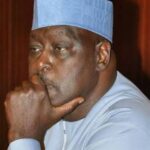
Shortly before Atiku was declared the ADC presidential candidate last week, his two opponents, former Transportation Minister, Rotimi Amaechi and corporate giant, Mohammed Hayatudeen, released separate statements to condemn the process, alleging widespread malpractices. And just when Atiku thought he had doused that fire by visiting both Amaechi and Hayatudeen at their respective homes, former Secretary to the Government of the Federation, Babachir Lawal, went rogue. In a scathing statement dripping with personal insults, Lawal writes off Atiku as unworthy of the presidency while also suggesting that the incumbent President Bola Tinubu (whom he still derides) would be better to continue. In a subsequent interview on Channels, Lawal cast more aspersions on Atiku.
Before I continue, let me say something quickly. Given the few encounters I have had with Lawal, I am not surprised by the tone of his statement. He is a man without filter whose politics revolve around identity: Ethnic and religious. That much can be discerned even from his attack on Atiku. I will recall two encounters to make my point. The first was shortly after his appointment as SGF by the late President Muhammadu Buhari in 2015. Lawal met a group of senior journalists and media owners from the North for what was supposed to be a background briefing about the administration he was serving. He spent more time eulogising a certain Bola Tinubu and made uncomfortable statements about the Fulanis despite the fact that his principal was a Fulani man and there were many in the room. On the praises he heaped on Tinubu, Lawal threw a bombshell: “Why won’t I praise Tinubu? Do you think any of my northern brothers would recommend a Christian like me for the position?” Lawal then went on a monologue about what he considered ethno-religious marginalisation of people like him in the North and the more some of us tried to ‘help him’ stay on message, the more he doubled down in a manner that suggested he really didn’t care what anybody might feel.
The second encounter was in a lighter mood, but it also revealed Lawal’s mindset. In August last year, former Sokoto State Governor, Aminu Tambuwal was released by the Economic and Financial Crimes Commission (EFCC) after being detained overnight. The next day, I was in Tambuwal’s house among many friends and political associates. Lawal, who also visited, dominated the discussion while joking that Tambuwal was released quickly because he is a Fulani man. “You spent just 24 hours with EFCC and they released you. In Nigeria, all animals are equal, but some are more equal than the others. Me, as a northern minority and Christian, I spent many days in detention…” Then looking in the direction of the former Imo State Governor, Hon Emeka Ihedioha, Lawal chuckled and said, “The day they catch our Nyamiri brother here, his own treatment will be special. He will spend at least a year in detention before they release him.”
In recent days, Atiku’s media minders have been responding to Lawal who, I am sure, enjoys the ‘roforofo’ fight. But for me, the real issue is how the ADC that was launched last year with fanfare as a vehicle to take out the incumbent has quickly unraveled. And the implications for the 2027 general election are not good. We often say that politics should be dictated by issues rather than personalities, but ideally it should be a combination of the two. On that score, the handlers of Atiku should be concerned that he is gradually being perceived as the undermining factor in the opposition that is not founded on shared ideals. Even before Babachir Lawal’s eruption, the belated discovery that the ADC was essentially built around Atiku had led to the exit of Mr Peter Obi and Dr Rabiu Kwankwaso both of whom now jointly fly the flag of the National Democratic Congress (NDC). And there is nothing to suggest that Amaechi and Hayatudeen are fully onboard Atiku’s presidential aspiration.
Ordinarily, the value of an opposition platform goes beyond the sum of its parts because the essence is to galvanise a kind of momentum within the populace that change is possible. Such a psychological boost will help to dent the myth of incumbent invincibility. Unfortunately, not only is the current opposition splintered in different political parties, even within those platforms, there is no unity of purpose.
I spent my year (2010/2011 academic session) as a Fellow at the Harvard Weatherhead Centre for International Affairs researching presidential elections in Africa, especially where the incumbent is on the ballot. The pattern I established is that a fractionalised opposition is unhelpful, to put it mildly. Dr Issaka K. Souaré, a senior governance and mediation advisor at the Institute for Security Studies, Pretoria, South Africa, described most opposition leaders within the continent as ‘macro democrats’ and ‘micro autocrats’ who preach what they don’t internalise. “The reason for this is that they form parties to seek power for themselves rather than to contribute to the democratic process in the country,” Souaré wrote. “If their leadership of the opposition coalition were not assured, they would rather go it alone even if they know that neither they nor another leader would win in a solo act.” This, of course, is not the issue for today.
Last Friday marked 27 years of unbroken civil rule in Nigeria. That we continue electing people who make no real commitment to which they could be held accountable is not only telling, but the results are also all too evident across the country today. It is therefore no surprise that Babachir Lawal’s ‘love note’ to Atiku is the trending topic at a time most Nigerians are finding it difficult to put food on their table and school children and their parents are being abducted on streets of major cities. But now that Lawal has retreated to his farm in Adamawa State where we hope (and pray) he doesn’t encounter the real Kachallas, it is important we refocus the conversation to what truly matters. But such a task must begin with a reorientation of the very parties whose platforms are used by the political loose cannons to speak. Since it is cheaper and easier to descend to the gutter of ethnicity, religion and name calling, parties not founded on definable ideas and values cannot produce leaders who champion definite directions.
Meanwhile, I began this intervention on the premise that Atiku should not be derided on account of age or record of his failed presidential bids. However, I am also aware that this is probably the last shot of the former vice president who would be 80 in November. While I will come back to interrogate what drives his aspiration as well as that of other serious contenders, ADC must put its house in order for its candidates to be taken seriously at the polls. Interested readers can access my 2011 publication on the implication of fractionalised opposition when the incumbent is on the ballot: https://olusegunadeniyi.com/projects/1077-divided-they-run-united-they-lose-how-fractionalized-opposition-strengthens-african-incumbents.html?lang=en.
- You can follow me on my X (formerly Twitter) handle, @Olusegunverdict and on www.olusegunadeniyi.com