Health of Mother Earth Foundation (HOMEF) has declared that the oil spill at the Nembe Creek facility in Bayelsa State has seriously disrupted fishing activities and threatened the livelihoods of several coastal communities.
This was as the Executive Director of HOMEF, Dr Nnimmo Bassey, stressed that identifying the cause of a spill must not be the end of accountability.
Bassey said; “The latest incident comes against the background of previous pollution incidents associated with OML 29, including the prolonged 2021 Santa Barbara Well 1 spill wellhead blowout”.
HOMEF therefore called urgent cleanup, compensation, and full accountability following the spill that occurred on Saturday, August 22, 2026, during crude oil loading operations at a facility operated by Nembe Exploration and Production Limited, formerly Aiteo Eastern Exploration and Production Limited, within OML 29.
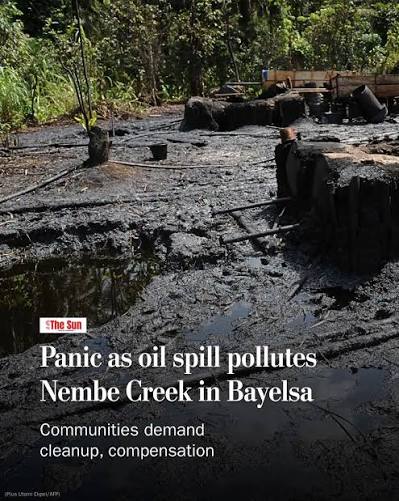
A statement by HOMEF stated that a field visit by it officials revealed crude oil in the water and along the mangrove banks around Nembe Creek.
It also said that the pungent smell of crude was noticeable approximately two kilometres before reaching the community, while residents reported that tidal movements had spread the pollution through interconnected waterways and fishing settlements.
According to HIOMEF, the affected communities depend heavily on fishing for food and income, adding that residents also reported damaged fishing nets, loss of fish catches, inability to use the river for fishing and domestic purposes, and the disappearance of aquatic resources.
Speaking on the incident, the Vice-Chairlady of Nembe Creek women, Love Mark, said that a result of contamination by crude oil, residents can no longer go out with their nets and hooks for fishing again.
Mark also said fishing nets contaminated by crude oil had become unusable, with individual nets costing between N150,000 and N170,000.
Also speaking, the paramount ruler of the Nembe Creek communities, HRH Agent Anthony Waya, said that repeated pollution had severely affected fishing livelihoods in the area.
In the words of Waya; “Due to the destruction of the aquatic lives, there are no fish in the river; people would go fishing in two or three canoes and return with nothing”.
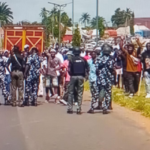
As a result of the spill, community women protested at the oil facility, demanding cleanup, assessment of the damage and support for affected residents.
This was as Joint Investigation Visit (JIV) reportedly identified operational failure as the cause of the latest spill, stressing that the volume of crude released and the full geographical extent of the pollution remained inconclusive as of 1st September 2026.
HOMEF particularly said that recurring spills must be treated as a systemic environmental governance concern rather than isolated incidents.
It therefore called on Nembe Exploration and Production Limited, the Bayelsa State Government and relevant federal regulatory authorities to publish the complete JIV findings, including the cause, estimated volume, geographical extent and affected communities.
HOMEF also called for the conduct of an independent and comprehensive environmental assessment of affected waterways, mangroves, fishing grounds and settlements and to immediately commence comprehensive cleanup and ecological restoration, with clear timelines and transparent monitoring.
It further stated; “Provide urgent relief to affected households, particularly fishing families whose livelihoods have been disrupted.
“Compensate affected residents for verified livelihood and economic losses, including damaged fishing equipment and lost fishing time.
“Include all affected communities and fishing camps in environmental assessments, JIVs, damage evaluation, cleanup and monitoring.
“Undertake sustained environmental and health monitoring of water, sediments, fish and other aquatic organisms.
“Strengthen spill prevention and emergency response systems around crude-loading facilities and to address the wider legacy of pollution in OML 29 rather than responding to each spill as an isolated event,” it stated.
HOMEF also called for the protection of community fishing livelihoods from the wider operational footprint of crude-loading activities, including the impacts of navigational buoys and vessel movements on fishing grounds and equipment. It specifically said that communities cannot continue to bear the environmental and economic costs of oil extraction while accountability remains limited.
HOMEF insisted that authorities and the operator must move beyond emergency responses and ensure that pollution prevention, transparent investigation, meaningful community participation, ecological restoration and livelihood recovery become integral to environmental governance in Nembe.
It stressed that the people of Nembe Creek deserve clean waters, protected livelihoods and environmental justice; not recurring pollution and repeated promises of relief.