- Acknowledges Moniepoint’s financial inclusion strides
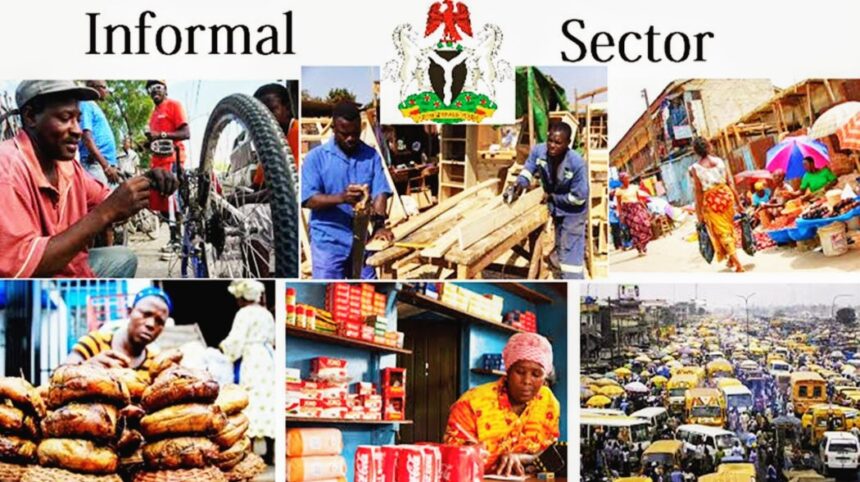
BY EDMOND ODOK – The Federal Government says resilience, creativity and enterprise have fully placed the informal sector on a pedestal as the heartbeat of Nigeria’s economy.
This is as the country boasts of over 39 million Micro, Small and Medium Enterprises (MSMEs) that doggedly account for about 96 percent of all businesses.
Additionally, the sector currently contributes 50 percent to the nation’s Gross Domestic Products (GDP), while employing over 84 percent of the workforce.
The Vice President, Senator Kashim Shettima, who gave this insight while unveiling of the second Informal Economy Report by Moniepoint Microfinance Bank in Abuja, said the present administration places high premium on the informal sector to drive the economy forward.
 He said “From market traders to artisans, service providers, and young digital entrepreneurs, millions of Nigerians power commerce daily in ways that are unseen yet indispensable to our economy”.
Represented at the event by Minister of Industry, Trade and Investment, Dr Jumoke Oduwole, the Vice President further said, “This report provides an important window into your world and the opportunities they create, the challenges you face and the scale of your contribution to national development. By grounding these insights in both data and lived experiences, it gives us a stronger foundation for inclusive and evidence-based policy making.”
Also pledging Federal Government support to FinTech companies operating in Nigeria to upscale their footprint, particularly across the African market, Vice President Shettima praised Moniepoint for its ten years of dedicated contributions to financial inclusion, supporting millions of informal businesses across Africa.
The Minister further assured that the President Bola Tinubu-led administration remains committed to creating favourable conditions for trade to thrive across Africa, adding, “And we are positioned in Nigeria at the forefront of Africa’s digital transformation.”
She said, “The informal economy lies at the heart of Nigeria’s story of resilience, creativity, and enterprise, from market traders and artisans to small service providers and young digital entrepreneurs, millions of Nigerians, power commerce daily, often in ways that remain on scene, yet indispensable to our economy.”
While reaffirming government’s commitment to building an enabling environment where entrepreneurs can thrive by simplifying registration and compliance, Dr Oduwole said all necessary measures are being taken to improve access to finance and equip business owners with the skills and tools to scale up their investments on a sustainable basis.
On his part, the Minister for Youth Development, Ayodele Olawande, appreciated millions of young Nigerians who, against all odds, rise daily to create value as traders, artisans, digital entrepreneurs, transporters, small-scale producers, and countless other jobs.
Describing the youth as value addition to Nigeria’s economic potential, the Minister said, “You are the heartbeat of Nigeria’s economy. Your creativity, resilience, and enterprise inspire us all. This administration sees you, values you, and stands ready to support you.”
He stated that the report released by the Moniepoint shows a sector marked by resilience and fragility, powered by the creativity, perseverance, and hard work of millions of Nigerians, most of whom are young people.
Olawande further said the findings show that while unemployment remains a key driver for participation in informal ventures, these enterprises have become a lifeline for economic survival and a source of dignity and purpose for many.
Noting that four in every ten participants in the informal economy are themselves employers of labour, the Minister said the development is a clear indication that the sector is not just a refuge, but a crucial engine of job creation.
“We are pursuing partnerships to expand access to credit, promote financial literacy, encourage innovation, and strengthen linkages between the formal and informal sectors.
“With the right support, the energy and ingenuity of our youth will become the engine that drives Nigeria’s inclusive prosperity,” the Minister said.
In his remarks, the Managing Director of Moniepoint Microfinance Bank, Babatunde Olofin, described the Informal Economy Report as more than just a study, stressing that mirrors Nigeria’s economic reality, especially for millions who make their living outside the formal system.
He said with critical support from the International Finance Corporation (IFC) as well as the Federal Ministry of Industry, Trade and Investment, SMEDAN, and other stakeholders, the bank has continued to provide policymakers and ecosystem stakeholders with data and insights that can drive inclusive and evidence-based decisions.
The Moniepoint boss said, “Our shared goal is to unleash Nigeria’s full economic potential and ensure that the most vulnerable households are not left behind -Actionable reports and case studies are a key instrumentality for us in delivering on this goal.”
For him, with this year’s report digging deeper into unemployment, taxation, savings behavior, and business operations within the informal economy, the picture painted is that of both resilience and fragility, adding, “These insights remind us that the informal economy is not just a tool for survival but a living ecosystem of innovation, and adaptation.”
Other speakers at the event included Special Adviser to the President on Job Creation and MSMEs, Temitola Adekunle-Johnson, and Director-General of SMEDAN, Charles Odii
For Adekunle-Johnson, Moniepoint deserves high commendation for empowering millions of small businesses through affordable financing and lifting many out of poverty with their various offerings.
In his intervention, Director-General of SMEDAN, Charles Odii, noted that small business ownership nationwide now stands at over 39.6 million nationwide, even as he hinted that SMEDAN, is partnering with the Corporate Affairs Commission (CAC) on free registration for 250,000 informal businesses to encourage formalization and access to government support.
“We are formalizing small businesses at no cost. The goal is to give them identity, access to finance, and inclusion in the formal economy”, he said, while also disclosing that government is offered incentives to businesses earning below ₦15 million annually by way of exempting from paying Company Income Tax (CIT).
Meanwhile, the report indicated that women dominate the informal sector and remain the most resilient operators, while youth participation continues to grow rapidly, requiring targeted support.
However, it also noted that informal business costs have risen by 80 percent over the past year due to inflation and operational challenges, even as the sector continues to generate significant employment and drive productivity