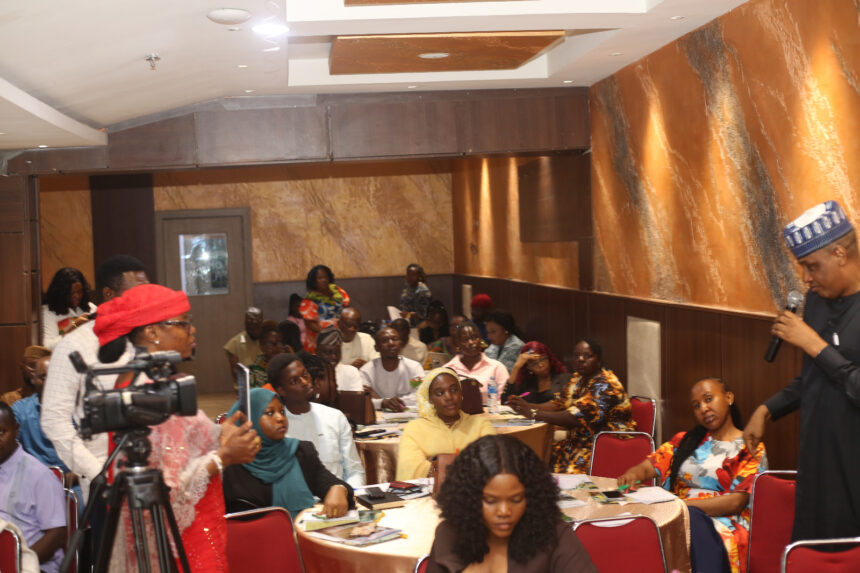
Participants at a national Stakeholders’ Workshop on Industrial Livestock Farming that took place in Abuja have challenged the Federal Government to as a matter of national interest, immediately and without precondition, publish the full Memorandum of Understanding (MoU) and all associated agreements, financial commitments, incentives, concessions, and government guarantees relating to the JBS investment in Nigeria.
The workshop which was organised by the Health of Mother Earth Foundation (HOMEF) and Environmental Rights Action (ERA), in collaboration with Youth in Agroecology and Restoration Network (YARN) and HEDA Resource Centre, declared that the demand is a non-negotiable baseline for this project to have any democratic legitimacy.
The workshop which witnessed the coming together of key stakeholders from government, academia, civil society, local farming communities, environmental groups, health sectors, and the private sector, examined the implications of the growing threat of JBS’s entry and expansion into the Nigerian market, and its potential to destabilise even further Nigeria’s food sovereignty and food systems, environmental sustainability and public health.
It noted that the Nigerian Investment Promotion Commission (NIPC) 2024 Annual Report records a US$2.5 billion proposed investment by JBS over four to five years, stressing that a Letter of Intent had been signed and that NIPC was following up with JBS concerning implementation of six state-of-the-art meat and poultry processing plants across Nigeria.
The workshop noted that the plan included building six facilities in Nigeria: three poultry plants, two beef processing plants, and one port facility, adding that the Nigerian government has pledged to provide the necessary and favourable economic, sanitary and regulatory conditions to support the successful implementation of the project, seeing as it has a huge potential for revenue generation.
Workshop participants observed that Industrial animal farming is structured, by design, around profit maximisation as its primary objective; and not food security, environmental sustainability, or not community wellbeing.
A communique issued at the end of the Stakeholders workshop and signed by Health of Mother Earth Foundation (HOMEF), Environmental Rights Action, YARN and HEDA Resource Centre, stressed that any policy framework that invites this model into Nigeria’s food system without binding public interest obligations is inviting an actor whose institutional purpose is not aligned with Nigeria’s development goals.
The workshop noted that the proposed US$2.5 billion JBS investment in Nigeria, covering six large-scale livestock processing facilities across six states, is still an announced figure, with no money already committed or disbursed and therefore cautioned that Nigeria must evaluate the proposal on its actual terms, as against headline number.
The communique particularly noted that no full agreement has been made public, stressing that the MoU and other associated documents have not been disclosed, and Nigeria’s public which includes the farmers and communities most directly affected, cannot assess what has been agreed on their behalf.
The communique further stated; “In July 2026, the same period in which JBS’s Nigerian expansion is under discussion; the company quietly dropped its Net Zero by 2040 target and removed its earlier time-bound zero-deforestation commitment from its sustainability reporting framework.
“A company retreating from its own environmental commitments at the same moment that it is seeking to enter Nigeria’s food system is not a company Nigeria should trust to self-regulate.
“Should Nigeria accept JBS’s entry, Nigerian farmers might not retain bargaining power, land and market access, and economic independence within such an arrangement,” it stated.
The workshop participants emphasised that if a Nigerian farmer cannot say “no” to JBS and still find a viable market, the issue is not investment but one of market capture, arguing that large-scale industrial processing without adequate safeguards risks subordinating smallholder and medium-scale farmers to a single buyer with enormous market power.
Participant stated that it calls for fair contracts, transparent pricing, access to alternative markets, and protection from anticompetitive concentration being guaranteed, and not assumed.
The communique further stated; “Nigeria’s EIA Act (Cap E12) requires an environmental impact assessment before project commencement. Niger State’s own Ministry of Environment has confirmed that it was excluded from the planning process, and no Environmental and Social Impact Assessment has been published. We’re seeing that Nigeria’s own legal are not being applied.
“The JBS investment is not, in full, foreign money. According to Goldman Sachs analysis reported in international media, JBS will fund approximately 55% of the total project cost, with Nigerian government agencies and local investors expected to provide the remaining 45%.
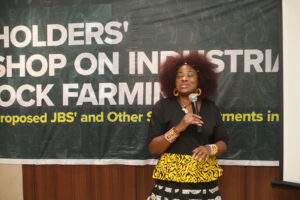
“Niger State’s House of Assembly approved an NGN 20.4 billion loan in support of the arrangement in June 2026. Nigerian public resources are materially at risk, and Nigerians have a right to know that their government is co-investing their money in a deal whose terms have never been made public,” the workshop stated.
The workshop particularly noted that the exclusion of the Niger State’s Ministry of Environment from the planning process for the JBS investment constituted a violation of Nigeria’s EIA Act and cannot be retrospectively cured by procedural compliance after the fact.
It also noted that Nigerian citizens whose taxes, public resources, and state borrowing capacity have been committed to this investment, without their knowledge or consent, have an unconditional right to full disclosure of the financial terms of that commitment.
Participant insisted that a deal that is partly publicly funded cannot be treated as a private arrangement, stressing that the off-take model at the heart of the JBS proposal (under which JBS positions itself as the primary buyer of livestock raised by Nigerian farmers) carries an inherent risk of converting independent producers into captive suppliers of a single dominant buyer, further throwing Nigeria’s food sovereignty and food systems in jeopardy.
The communique further stated; “Nigeria’s livestock sector merely lacks investment in what already exists. The problem is under-development of existing assets, not the absence of a viable foundation, and any investment framework that bypasses or displaces this foundation in favour of imported genetics and externally controlled systems is a substitution.
“The Nigerian government must develop and implement a dedicated national policy and financing framework for agroecological, regenerative, and integrated food production systems including guaranteed markets, subsidised inputs, technical extension services, cooperative development support, and land access mechanisms designed specifically for smallholder and cooperative producers. Sustainable alternatives must be resourced, not merely mentioned.
“The following minimum safeguards must be non-negotiable: full public disclosure of all agreements; independent environmental, social, land, water, and public health assessments; legal protection for farmers, pastoralists, workers, and affected communities; competition safeguards preserving farmers’ access to alternative buyers; measurable local sourcing, employment, skills transfer, and value-addition targets; and transparent, independent public reporting on compliance.
“Nigerian civil society, research institutions, farmers’ organisations, and government agencies must jointly build, document, and communicate a national evidence base for sustainable food system alternatives that Nigerian farmers have already proven works, at scale and under local conditions, so that policy, investment, and public discourse are anchored in Nigerian evidence rather than in the marketing narratives of foreign industrial operators.
“The Federal Government must initiate an immediate, inclusive, and farmer-centred review of the Land Use Act to address the structural insecurity of land tenure for smallholder and subsistence farmers. As currently enacted, the Act vests all land in state governors, creating conditions under which community land can be acquired for commercial purposes without adequate protection for those who depend on it for their livelihoods. This review must centre the rights of smallholder farmers, pastoralists, and rural communities, and must produce enforceable tenure protections that cannot be overridden by executive allocation or commercial agreement.
“The Federal and State Governments must invest in the construction and maintenance of accessible, farmer-managed storage facilities in rural and peri-urban agricultural communities, and must restore and significantly expand the network of agricultural extension services available to smallholder farmers.
“The Federal and State Governments must ensure that host communities affected by the JBS investment (including farming communities, pastoralist groups, and settlements contiguous to proposed facility sites) own real shares in the Nigerian companies established to run this investment, and it must carry real voting rights as well as participation in governance decisions that affect community land, water, and livelihoods.
“Civil society organisations, media and journalists, community radio stations, and digital advocates must mobilise every available media and communication channel to ensure that the facts of the proposed JBS investment reach the farmers, pastoralists, and rural communities whose land, water, and livelihoods are most directly at stake. This includes social media campaigns headed by popular influencers to spread awareness.
“Nigeria’s food system, including its livestock sector, its smallholder farmers, its pastoralist communities, its land, and its water, all constitute a commons held in trust for present and future generations.
“No investment arrangement, however large, confers on any private entity the right to reorganise that commons without transparency, consent, and accountability to the people whose lives depend on it,” the workshop participants stated.