A coalition of Nigerian civil society organisations has declared that while its members are not opposed to investment in Nigeria’s agricultural sector, but their support is only for investment that is transparent, accountable, rooted in the needs of Nigerian farmers and communities, and aligned with international obligations to limit climate change and halt the loss of natural ecosystems that sustain us all.
The coalition therefore demanded for a transparent food future for the country and kicked against what it described as “negotiation behind closed doors”.
It noted that decisions being taken on the country’s livestock sector will determine who controls its land, water and food, in addition to whether the millions of farmers and pastoralists who feed the nation will have any say in them.
Members of the civil society organisations made up of Uouths in Agroecology and Restoration Network (YARN), Environmental Rights Action/Friends of Earth Nigeria (ERA/FoEN) and Africa Coordinator Stop Financing Factory Farming (S3F), Health of Mother Earth Foundation (HOMEF), Youth for Environmental Sustainability and Development (YESD), and Community Development and Climate Care, farmer groups, pastoralist associations, youth and women’s groups, and environmental and animal-welfare organisations amongst others, at the close of a three-day strategy workshop held in Abuja from 22 to 24 September 2026, renewed their call for full transparency over the proposed US$2.5 billion investment by the meat corporation JBS to establish six industrial meat-processing facilities across Nigeria.
The coalition noted that nearly two years after the Federal Government signed a Memorandum of Understanding (MoU) with JBS, the agreement has still not been made public.
The coalition particularly raised concerns that no Environmental and Social Impact Assessment (ESIA) relating to the project has been published.
While recognising the importance of responsible investment in Nigeria’s agricultural sector, the coalition of civil society organisations stressed that an investment capable of reshaping the country’s food system must strictly align with international agreements and uphold fundamental human rights.
The workshop participants specifically reminded the Federal Government of its obligations under Article 24 of the African Charter on Human and Peoples’ Rights, which guarantees the right of all peoples to a general satisfactory environment favourable to their development.
The coalition further stated; “A US$2.5 billion industrial livestock expansion without public oversight or published impact assessments directly jeopardises this right.
“We express solidarity with communities in Niger and Ogun States at the frontline of the expansion in Nigeria whose rights have not been honoured,” it stated.
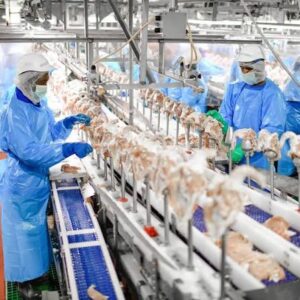
The three day workshop particularly drew attention to JBS’s global record – the linkage of JBS’s supply chain to deforestation in Brazil and to labour and land-rights violations, and the company’s recent removal of explicit protections for Indigenous peoples and land rights from its human rights policy and its abandonment of its Net Zero 2040 climate and zero-deforestation pledges.
The coalition members further stated; “We warn that Nigeria should heed the experience of Australia, where JBS arrived in 2007 with promises of investment, jobs and food security and, within two decades, grew into the country’s largest meat processor, exporting most of what it produces there. “We stress that more output alone does not mean greater food security; what matters is who benefits, who holds power, and whether the farmers, communities, animals and ecosystems that make up Nigeria’s food system are strengthened or displaced.
“Based on the foregoing, we reiterate that our requests under the Freedom of Information (FOI) Act 2011 to the Federal Ministry of Livestock Development, Ogun State Ministry of Agriculture and Food Security, and the Niger State Ministry of Livestock and Fisheries, seeking the MoU, related agreements, ESIAs and records of engagement with JBS, have not been honoured.
“We note that while the headline figure of US$2.5 billion is public, the lender terms, the allocation of funds and the beneficial ownership of the private investment vehicles involved remain undisclosed.
“We maintain that without this information, citizens cannot know whether public land and public resources are being committed to private gain. We respectfully remind officials that the FOI Act gives every Nigerian the right to this information, including the right to seek enforcement through the courts,” it stated.
The coalition vowed that its members will pursue every lawful avenue to secure disclosure, just as it emphasised that the JBS investment cannot be separated from the Federal Government’s National Livestock Transformation Plan and Nigeria Livestock Master Plan (2026–2040).
While welcoming the aim to reduce farmer–herder conflict and modernise the livestock sector, the coalition however, expressed concern that consultation on the reforms has so far fallen short of the standards Nigeria has committed to under the Open Government Partnership.
It stressed that Nigeria already has functioning food systems built by pastoralists, smallholder farmers and traditional producers, and that the natural systems that underpin them deserve investment and protection rather than replacement. These must align with global agreements to limit climate change and biodiversity loss.
Accordingly, the coalition demanded that both the federal and state governments should as a matter of urgent national concern, respond without further delay to all outstanding FOI requests at federal and state levels, in accordance with the Freedom of Information Act 2011.
The coalition also demanded for the conduct and publication of a comprehensive, independent Environmental and Social Impact Assessments, including cumulative impacts on land, water and ecosystems, before any further land allocation, approval or construction.
Other demands by the coalition included; “Guarantee the free, prior and informed consent of affected communities, and undertake genuine consultation with farmers, pastoralists, women, youth and civil society before decisions are taken, not after.
“Urgently address the grievances of communities in Niger State whose land has been acquired, including resettlement, unfulfilled promises and access to water.
“Align the National Livestock Transformation Plan and its pilots with Nigeria’s international commitments on climate and biodiversity, and its open-government commitments, including published budgets, grievance mechanisms, and independent monitoring that includes civil society.
“Establish enforceable safeguards to protect smallholder farmers’ and pastoralists’ access to markets, animal welfare, waterways and groundwater, and public health.
“Prioritise investment in agroecology, indigenous seed and resilient local food systems that strengthen the livelihoods of Nigerian farmers and pastoralists, and the natural world that sustains them,” it demanded.
The coalition noted that Nigeria today has an advantage that Australia did not have in 2007, stressing that with the benefit of hindsight, agreements capable of transforming the nation’s food system must not be concluded behind closed doors.
The participants at the workshop insisted that the people whose land, water and livelihoods are at stake must be heard before, not after, decisions are made and declared that transparency is not optional.
The coalition said; “It is the foundation of food security. Nigeria’s food future must be built on public accountability, food sovereignty, environmental integrity and the voices of the people who grow the nation’s food.