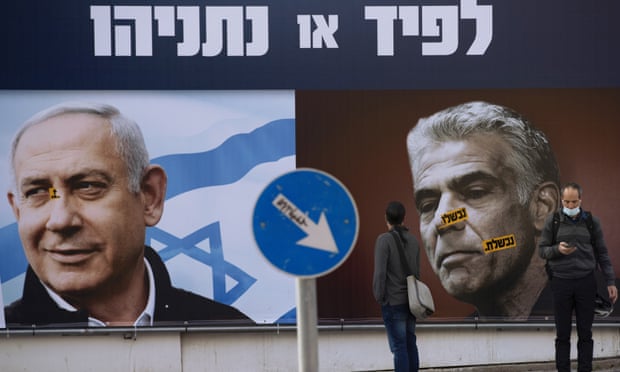
- Says president can form a government
- New deal proposes far-right politician, Naftali Bennett as PM

Israeli opposition leader, Yair Lapid has secured the crucial backing of Arab Islamist MPs for his proposed coalition that will oust Prime Minister Benjamin Netanyahu from power.
He told the country’s President, Reuven Rivlin that he can form a government, a critical step that puts Netanyahu in his most precarious political situation for more than a decade.
After days of frenetic negotiations, Lapid told President Rivlin, less than an hour before a midnight deadline, that he had the support of a majority of opposition parties for what has been called a “government of change” – a mix of bitter ideological rivals united by a shared desire to remove Netanyahu as Israel’s longest-serving leader.
Under the proposed deal, Lapid will not immediately take the high office. Instead, his former rival and far-right politician, Naftali Bennett, whose support was vital to the coalition’s success, will become Prime Minister for the first two years.
“I am honoured to inform you that I have succeeded in forming a government,” Lapid said in his message to the president.
He further said; “I commit to you Mr President, that this government will work to serve all the citizens of Israel, including those who aren’t members of it, will respect those who oppose it, and do everything in its power to unite all parts of Israeli society.”
Crucially, Lapid secured backing from a small party of Arab Islamists that signed roughly two hours before the deadline. In doing so, the United Arab List became the first party from Israel’s sizeable Arab minority to join a government. Its leader, Mansour Abbas, is a pragmatist and has sought greater resources and rights for Palestinian citizens of Israel.

However, the step by Lapid does not immediately end Netanyahu’s 12-year stretch in power or conclude a political deadlock that has brought four snap elections since 2019. Before that happens, lawmakers will need to vote on the deal, which is expected next week. Then there will be a swearing-in.
If the deal finally sails through, Bennett would become Prime Minister for the first two years. Until that happens, Netanyahu is expected to continue his attempts at getting any lawmakers to defect so Lapid does not have a 61-seat majority in the 120-seat Knesset.
Netanyahu did not immediately comment on the deal, but Miki Zohar, a lawmaker in his ruling Likud party, wrote on Twitter: “This is a very sad day for the State of Israel.”
Bennett, a religious nationalist, is a strong advocate for the settler movement in the Palestinian territories and has ruled out a Palestinian state.
The 49-year-old envisions Israel annexing most of the occupied West Bank and is infamous for incendiary comments about the Palestinians.
In 2018, he said Israeli troops should have a “shoot to kill” policy for “terrorists” attempting to cross the Gaza frontier, including children. As Education Minister, he sought to ban advocacy groups critical of the military or the state from speaking in schools.
He will be joining with an unlikely assortment of parties, including the establishment Labour and anti-occupation Meretz but also Yisrael Beiteinu, a hard-line secular party led by a Moldova-born settler, Avigdor Lieberman.
Abbas, the leader of the United Arab List, said his party had made a “difficult decision” to join the coalition. “This is the first time an Arab party is a partner in the formation of a government,” he told reporters.
“This agreement has a lot of things for the benefit of Arab society, and Israeli society in general.”
While Lapid is a self-proclaimed centrist, he has also described himself as a “security hawk” and provided only tepid encouragement to the prospect of ending the occupation.
To avoid breaking apart, his fragile government would be expected to focus on the economy and the pandemic while avoiding addressing the big issue of millions of Palestinians living under Israeli rule.
Bennett will have executive powers as the Prime Minister to effect change or entrench the status quo. Also, analysts have speculated the government, even if sworn in, may only last a short time if the sense of unity fades and deep discord resurfaces.
Netanyahu, who has been in power for a total of 15 years, from 1996 to 1999, and then since 2009, has been desperately attempting to scupper his opponents’ deal which could threaten not only his political life but his freedom, too.
The 71-year-old leader is currently fighting three corruption cases, bothering on fraud, bribery, and breach of trust charges, which he denies.
If he were to go into opposition, he could be denied parliamentary immunity and the new government could pass legislation to bar him from office.
Lawyers for Netanyahu’s Likud Party had already tried to stop the emerging coalition this week by stating Bennett’s right to serve first as Prime Minister was illegal. But President Rivlin knocked down the challenge.
On Sunday, Netanyahu warned of “a left-wing government dangerous to the state of Israel” and accused his former allies of the right of abandoning their voters. – The Guardian
 A photo of Abbas, Lapid, and Bennett sitting and smiling together, apparently after signing the coalition agreement, widely shared on social media by stunned Israelis. “History,” wrote Noa Landau, a journalist for the local Haaretz newspaper