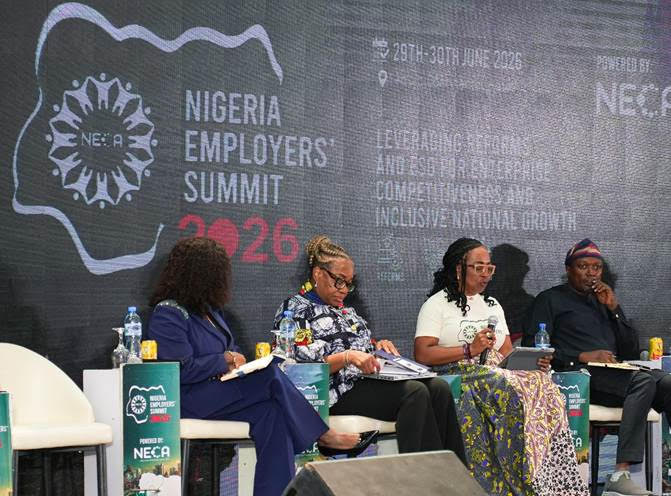
The Company Secretary of Julius Berger Nigeria PLC, Mrs Cecilia Ekanem Madueke has canvassed an ecosystem-wide approach built on early stakeholder alignment, robust community engagement, proactive risk management and stronger coordination among all levels of government and the private sector as sine qua non for improving the ease of doing business and providing infrastructure efficiently.
Madueke spoke at a two-day Summit organised by the Nigeria Employers’ Consultative Association (NECA) with the theme; ‘Leveraging Reforms and ESG for Enterprise Competitiveness and Inclusive National Growth’.
The event brought together, employers, policymakers, business leaders and industry experts to examine how regulatory reforms and Environmental, Social and Governance (ESG) principles can strengthen Nigeria’s business environment.
As a discussant during Plenary 4 on the second day of the summit, Madueke, who spoke on Enhancing Ease of Doing Business and Addressing Regulatory Overlap: ‘Deepening Private Sector Collaboration for Sustained Outcomes,’ highlighted the need for stronger stakeholder coordination and early risk identification to improve the investment climate and ensure the successful delivery of infrastructure projects.
While responding to a question on the importance of redesigning regulatory processes to improve predictability for major infrastructure investors, Madueke noted that infrastructure delivery depends on managing a complex web of stakeholders whose interests and responsibilities intersect across different levels of government and society.
We have the national, the sub-national and the local levels. We are dealing with different stakeholders, and it is a complex ecosystem,” she said. “It is a very delicate task to coordinate all these interests if we are to achieve the ultimate objective, which is the successful delivery of infrastructure, she said.
Madueke explained that project approvals often extend beyond regulatory agencies, involving federal institutions, state governments, local councils and host communities, all of which can significantly influence project timelines and outcomes.

In the words of Madueke; “Approvals go from the national level to the sub-national, the local government and even the community. Every one of these levels has an impact on the success of a project”.
To illustrate the challenges involved, she recounted an experience during the implementation of a road infrastructure project in Nigeria’s South-South region, where the relocation of a local shop became a critical issue requiring extensive stakeholder engagement.
“We found ourselves dealing with the relocation of a shrine. That is not something the Federal Government alone can solve. It is not something the state or even the Local Government can resolve in isolation. It is fundamentally a community issue, and that requires engagement and consensus,” Madueke said.
She further said that such experiences demonstrate that infrastructure development goes far beyond engineering expertise and financing, adding that success also depends on building trust and maintaining constructive relationships with host communities.
According to Madueke; “If you do not have the right relationships on the ground and the capacity to engage communities effectively, you will struggle to move projects forward”.
She noted that reducing regulatory bottlenecks required stakeholders to identify risks and potential points of concern from the earliest stages of project planning rather than waiting until implementation begins.

She said; “We need to identify the risks from the very beginning. We need to understand the issues, determine who should drive each process and ensure that everyone is aligned before projects commence. That is how we minimise delays and improve project outcomes”.
Madueke also said that improving the ease of doing business is a shared responsibility that extends beyond government institutions, adding that, this is not just a Federal Government issue, but an ecosystem issue.
“Government, the private sector and communities all have critical roles to play if we want sustainable infrastructure development and investment,” Madueke said.
She concluded by advocating stronger institutional coordination, greater alignment among stakeholders and continuous engagement with host communities as key drivers of a more predictable investment climate and efficient project delivery.
Meanwhile, Julius Berger’s exhibition stand attracted a steady stream of visitors, including business executives, employers, industry stakeholders and conference participants, just as discussions focused on the company’s operations across Nigeria and its contributions to national infrastructure development.


This was as several visitors commended Julius Berger’s role in delivering major infrastructure projects nationwide, including roads, bridges, buildings and other critical assets that support economic growth.
The exhibition also provided an opportunity for the company’s representatives to engage stakeholders on emerging trends and developments within the construction and infrastructure sectors.