BY COBHAM NSA – Nigeria has unveiled a massive $78.5 billion investment pipeline to international backers while demanding a demanding a radical overhaul of the global financial architecture that translates its current macroeconomic stability into faster job-rich growth
The high-stake move signals the country’s shift from defensive economic stabilization to aggressive growth, with the Federal Government explicitly conditioning foreign market access on structural changes that favour developing economies.
Clearly making an aggressive push in weaponising its hard-won fiscal stability on the global stage, the Federal Ministry of Finance said the country had showcased progress in economic reforms while urging international financial institutions to prioritise growth that creates jobs on sustainable basis.
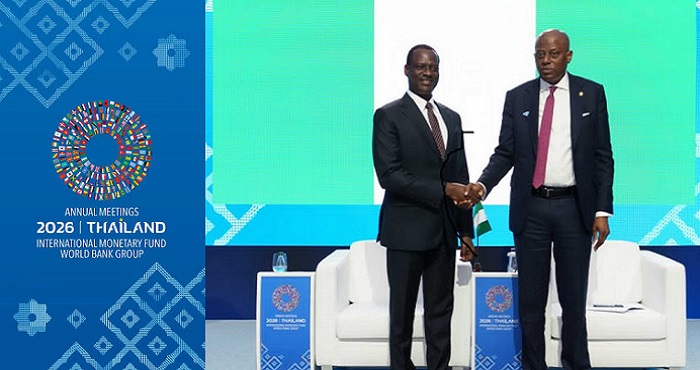
The Minister of Finance and Coordinating Minister of the Economy, Taiwo Oyedele, and the Governor of the Central Bank of Nigeria (CBN), Olayemi Cardoso, led Nigeria’s charge on fairer global financial system translating its recent macroeconomic stability into immediate job creation and rapid economic growth in a presentation at the 2026 Annual Meetings of the International Monetary Fund (IMF) and World Bank Group in Bangkok, Thailand.
A statement issued on Saturday to signal the conclusion of Nigeria’s participation highlighted its second-quarter 2026 economic growth of about 4.4 per cent, four consecutive months of declining inflation, foreign reserves exceeding $55 billion, a tax-to-GDP ratio of 12.5 per cent and public debt equivalent to 36 per cent of gross domestic product (GDP).
According to the statement, a key outcome of the meetings was the launch of Projects Nigeria, a portfolio of 65 bankable investment projects valued at approximately $78.5 billion with the Ministry indicating that the initiative had attracted Expressions of Interest (EoI) from investors in Asia and Europe, though information on the projects’ individual values, sectors or the specific commitments secured were not disclosed by the governement.
The statement said Nigeria also secured World Bank Group support for power and infrastructure development through guarantee instruments designed to help mobilise financing for strategic investments, just as the IMF is expected to continue providing the country with technical assistance in fiscal governance, transparency and statistical development.
Additionally, the government secured commitments from the Japan International Cooperation Agency (JICA), the United States Treasury and the European Union to deepen cooperation with Nigeria, the statement said, stressing that beyond investment mobilisation, Nigeria used the meetings to advocate reforms to the international financial architecture, particularly the need for developing economies to access affordable and sustainable financing.
With the country concluding its Group of 24 (G-24) chairmanship, where it pushed for a quota-based IMF system, fairer sovereign credit ratings, and lower financing costs for developing nations, Oyedele warned that the global economy risks jobless growth as artificial intelligence transforms labor markets.
Citing World Bank projections showing that while about 1.2 billion young people will enter the workforce over the next 15 years, only 400 million jobs will be available, the Minister urged the IMF and World Bank to make employment creation a central measure of economic performance, arguing that macroeconomic stability must translate into tangible opportunities for citizens.
“Stability was the first test. Growth that employs our people is the second,” Oyedele said, noting that Nigeria’s reform agenda was intended to establish a foundation for sustainable growth, investment and employment, rather than stability as an end in itself.
As the curtains fall at the IMF and World Bank meetings in Bangkok, the Minister reaffirmed Nigeria’s strict commitment to fiscal reforms, explicitly ruling out a return to petrol subsidies or multiple foreign exchange rates.
With the high-level global engagements highlighting Nigeria’s urgent push to attract private capital, expand crumbling infrastructure, and strengthen national economic resilience following aggressive structural shifts, ultimately, the Ministry said these dialogue sessions reinforced its dedication to international partnerships.
However, the critical challenge before the government is converting a massive $78.5 billion project pipeline into actual financing, tangible investments, widespread employment, and inclusive economic growth.