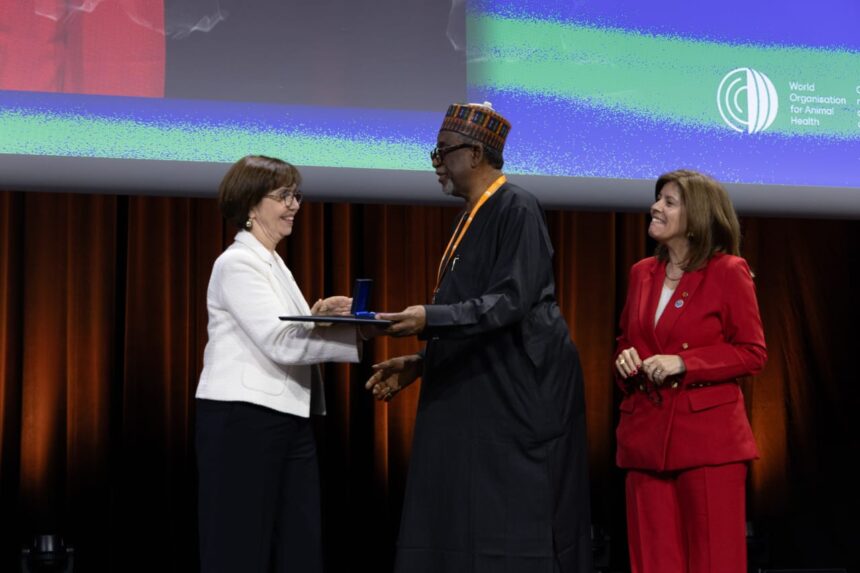
One of Nigeria’s foremost veterinary doctors, Dr Junaidu Ahmed Maina, has described the elimination of avian influenza within two years in the country as a testament to what coordinated action can achieve.
Maina, a former Chief Veterinary Officer of Nigeria (CVON) spoke shortly after he conferred with the 2026 Meritorious Award of the World Organisation for Animal Health (WOAH), said the nation must invest in education, mentorship, and opportunities that empower young veterinarians to lead, saying that their voices and ideas will carry the profession into the next century.
The award which was presented during a ceremony of the 93rd General Session of the WOAH World Assembly of delegates held at the CNIT Paris La Defense, was conferred on Dr Maina on behalf of the President of WOAH, Dr. Susana Guedes Pombo, in recognition of his impactful techno-scientific and administrative contributions in the animal health sector.
Maina in the statement on Wednesday, May 20, 2026, reeled out other gains of coordinated action to include; public awareness, risk communication, preparedness, and compensation, which he said are vital.
He noted that the outbreak showed how quickly misinformation can spread and how clear communication, coupled with fair and timely compensation, can reduce risk, support affected communities, and sustain public confidence.
Maina further said; “But victory can breed complacency. The 2015 resurgence of avian influenza in Nigeria reminded us that vigilance must never waver. Rising anti-vaccination sentiment today threatens progress, even as we recall the triumph of rinderpest eradication in 2011, the second disease after smallpox to be wiped out globally.
“Since 2012, the FAO-WOAH Joint Advisory Committee, which I had the honour to chair until 2022 has worked to safeguard this achievement. But as Mark Carney said: Nostalgia is not a strategy.
“Livestock are more than animals, they are engines of livelihoods, biodiversity, and climate resilience. Yet transboundary and emerging diseases continue to spread across borders, disrupt trade, and erode food security and sovereignty.
“The toll is stark; they drive over 20% of global production losses, undermining food systems and climate goals. We must rebuild trust in veterinary services, anchor decisions in science, restore confidence in vaccination, and curb antimicrobial resistance.
“That means stronger surveillance, faster response, resilient institutions, and sustained research investment. United action is our greatest force through partnerships among governments, associations, research bodies, and international organisations, we can safeguard animal health and strengthen food systems.
“And let us look forward. Africa is home to the youngest population in the world. The future of veterinary medicine will be shaped by their energy, innovation, and courage,” he said.
Dr. maina was the President of the Veterinary Council of Nigeria (VCN) from 2003 to 2006 and had worked extensively with World Bank-assisted projects, focusing on smallholder livestock production, specifically the Second Livestock Development Project.
The seasoned expert in Livestock Production was a Director in the Global Alliance for Livestock Veterinary Medicines from September 17, 2019 to September 16 2025.