“There is also a question of timing. Nigeria faces serious challenges in security, the economy, and public trust in institutions. Voters are weighing not just who can win, but who can govern”.
BY ACHILLEUS-CHUD UCHEGBU

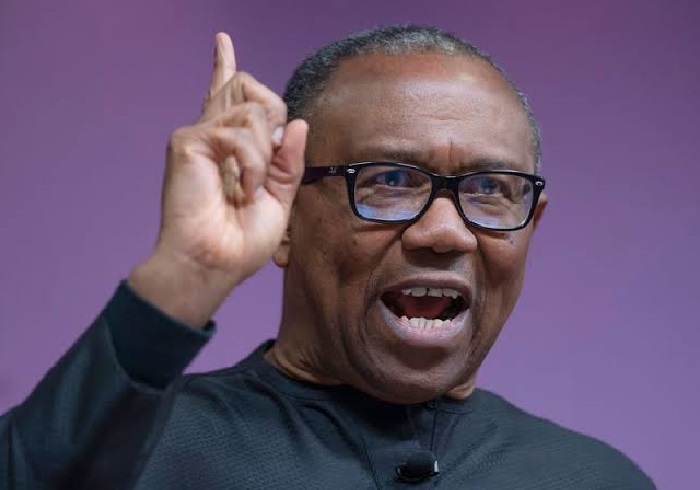
Every few election cycles, Nigeria’s political class is shaken by a figure who refuses to play by the familiar rules. In 2023, Peter Obi did not merely contest a presidential election under the banner of Labour Party, he, in fact, changed the conversation about what Nigerian voters could expect from a candidate. Now, as the presidential candidate of Nigeria Democratic Congress (NDC) for the 2027 contest, the question is whether the 2023 shift was a moment in history or the start of a movement. The evidence, so far from around Nigeria, points to a movement.
Start with the arithmetic of momentum. Obi was adopted as the NDC’s presidential candidate in May 2026, with former Kano state governor and former Minister of Defence Rabiu Musa Kwankwaso as his running mate. Since then, support for him has broadened beyond his traditional base. This has been followed by a rain of endorsements from different parts of Nigeria. And the ruling All Progressives Congress (APC) have been very unsettled. It has openly demonstrated this. When a candidate’s support base grows while he is being attacked from the highest levels of government, that is not a sign of weakness but a sign that voters are listening.
The attacks themselves tell a revealing story. Obi has been the principal target of the ruling party’s campaign, and his home state’s governor, Charles Chukwuma Soludo, has also cast him in opposition. But their position on Obi tells us something that students of politics know too well: that political leaders rarely fight this hard against a candidate they consider negligible. The intensity of the campaign against him reflects how seriously his rivals take the threat. For them, he is no longer the negligible minority they thought he is.
What makes Obi’s brand of politics, and his persona distinctive is not only his popularity but the kind of politics he asks Nigerians to practise. The most important of these is his stance on money in elections. Across the country, many voters have grown used to the distribution of cash, rice, cooking oil, noodles, seasoning cubes and other inducements in exchange for their votes. Supporters of Peter Obi argue that the APC has leaned heavily on this model, and may not make any impact in the campaigns without it. Others argue that without monetary inducements, APC’s campaign would have collapsed completely especially given the mass rejection is has faced with ‘bamayi’ chants across northern Nigeria. APC’s focus on monetary inducement has also corroded the link between citizens and their representatives. Under this view, a voter who is paid on election day has, in effect, sold the right to hold a government accountable for the next four years. Obi’s refusal to compete on that terrain, and his insistence that votes should be won on ideas, is therefore not a minor campaign choice. It is a challenge to the entire system of electoral patronage.
This is where Obi’s appeal is most profound. He is asking voters to judge him on a record and a plan rather than on what he can give them this period. His message on the economy has centred on jobs, the growth of micro, small and medium enterprises, and tackling corruption. His pledge to add at least 10,000 megawatts of electricity speaks to the infrastructure failures that touch every household and business. These are not promises that can be delivered with a bag of rice on polling day. They require institutions, discipline, and sustained public scrutiny, and that is precisely why they matter.
Consider also what a clean campaign would mean for the country beyond 2027. If a candidate can win substantial support without buying it, he makes it harder for future politicians to justify the practice. He raises expectations among voters, who begin to ask what their representatives will deliver rather than what they will hand out. He gives young Nigerians a reason to believe that participation is worthwhile. For a country where a large share of the population is young and many feel shut out of opportunity, that belief is no small thing.
Obi’s critics will say that he is simply the latest in a long line of charismatic candidates who have promised reform and disappointed. They point to his earlier party changes and argue that his politics is too dependent on personality, and not backed by inducements. The criticism often arrives in a familiar form, the assumption that Nigerian voters are too transactional to reward a candidate who will not buy their votes. The growing endorsements suggest otherwise. People are responding to a message of seriousness and integrity, and they are doing so in numbers that the political establishment did not anticipate.
There is also a question of timing. Nigeria faces serious challenges in security, the economy, and public trust in institutions. Voters are weighing not just who can win, but who can govern. A candidate who speaks plainly about corruption, who refuses to treat citizens as customers to be bought, and who has built a broad coalition across regions and ethnic lines offers something that much of the political class has struggled to provide. Whether he succeeds in 2027 will depend on the voters, but his candidacy has already changed the terms of the debate.
The most important legacy of Peter Obi’s politics may not be the outcome of any single election. It may be the expectation he is helping to build: that Nigerians deserve a government they can hold to account, and that a candidate’s worth should be measured by the ideas he brings and the record he keeps. If that expectation takes root, the country will be stronger regardless of who holds the presidency.
…Achilleus-Chud Uchegbu is an Abuja based journalist