It is becoming painfully familiar: the sound of gunfire, the rush for safety and the heavy silence afterward, broken only by cries of grief.
For many residents of Angwan Rukuba in Jos North Local Government Area, Sunday night was not just another attack. It was a horrific reminder that the past they have struggled to outlive is never far behind.
For years, Plateau State has carried the scars of repeated violence. From the September 7, 2001 crisis to the 2008 unrest and the Christmas Eve bombings of 2010 that tore through Angwan Rukuba, memories remain etched in survivors’ lives.
Each incident leaves behind its own stories of loss, resilience and unanswered questions. Sadly, on March 29, 2026, at about 7:46 p.m., the cycle returned.
Chaos in the community
The area was alive in its usual way: traders attended to customers, roadside vendors displayed their goods and relaxation spots buzzed with laughter and conversation. Then, without warning, gunmen stormed the community.
“They came in numbers,” recalls Mrs Sarah Adams (not her real name), her voice still shaken. “Some wore army uniforms, others plain clothes. They just started shooting, no warning, nothing. People were simply going about their normal lives.”
According to her, the attackers spoke Hausa and Fulani as they moved through the area, shooting indiscriminately. Some victims were gunned down on the spot. Others were attacked with machetes. In the chaos, survival was possible only through sheer instinct.
For 27-year-old Dorathy Adams, a roadside pork seller, the night will never be forgotten.
“I was at my spot when they arrived in a truck and started shooting,” she explains. “I ran, and one of them shot at me. The bullet brushed my neck. I fell down and pretended to be dead.” She pauses, as if replaying the dark moment in her tormented mind.
“They came back and shot the people I was with again. I could hear everything, but I didn’t move. That’s how I survived.”
For Dorathy, trauma lingers not only from her narrow escape but from watching life disappear in seconds. “You see someone talking to you one minute, and the next minute, they are gone,” she moans quietly.
Mr Adetunde Adeneyu had just left the area after visiting a family member when the gunshots rang out.
“I had barely moved when I started hearing gunfire everywhere,” he recounts. “People were running in all directions. It was confusion. Nobody knew where to go.”
By the time security forces arrived, residents say the attackers had begun retreating through a footpath around the Gari Ya Waye area. But even that moment brought more panic.
“People tried to go after them,” one resident explains, “but the situation got worse. There was shooting again, and it became total chaos.” Many now describe the attack as coordinated and planned with precision, executed with chilling ease.
The human toll
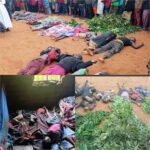
As dawn broke, the scale of the tragedy became clearer. Engineer Ashoms Azi of the State Emergency Management Agency stood near the scene, where bodies still lay.
“It’s so unfortunate that the state has to go through this period of grief,” he says. “There are corpses behind me right now as a result of this attack.”
According to him, several victims were already receiving treatment in both public and private hospitals, while others did not survive their injuries.
“We are on ground assessing the situation to determine how best to provide humanitarian assistance, especially trauma care, healing, and other essential support,” he explains.
Beyond immediate relief, the emotional toll is already evident. Community leaders, visibly shaken, are urging calm even as anger simmers.
Hon. Ladi Dan Diop, Councillor representing Naraguta B Ward, struggles to find words as he gestures toward the scene. “The people killed here are innocent children, even people who are not mentally stable.
These are not people you expect to be targets,” he states. “For now, what we need most is security presence. The community needs to feel protected.”
For religious leaders, the pain cuts across identity lines. Rev. Dunka Gomwalk lamented: “This is terror, pure and simple. Nobody deserves to die like this. These are human beings, not animals.”
He urges restraint among residents, even in the face of grief. “No matter how painful it is, we must not take the law into our own hands. But at the same time, there can be no peace without justice. We must get to the root of this.”
Gideon Para Mallam said the timing of the attack adds another layer of anguish in the state.
“It happened on Palm Sunday,” another community figure notes. “Exactly one year after the killings in Zike. We had prayed that nothing like that would happen again.” But it did.
At least 28 people were reportedly killed, including a pregnant woman – a loss residents say cannot be counted as just one life. Questions are now being asked, not only about the attackers but about the systems meant to prevent such tragedies.
When eyewitnesses say the attackers wore military uniforms, it raises serious concerns,” one leader points out. “How do they get access to such uniforms? These are issues our security agencies must address.”
Yop Kyatta, Special Adviser to the Jos North Local Government Chairman and a resident of Angwan Rukuba, said the atmosphere in the community was one of pain, anger and grief.
She disclosed that Governor Mutfwang had visited the community to commiserate with residents and assured them that the perpetrators would be brought to justice.
Governor Mutfwang visits
Plateau State Governor Caleb Mutfwang visited the affected community, standing with residents in mourning and solidarity. Visibly moved by the scale of destruction and loss, the governor described the incident as heartbreaking and assured residents that the government would not allow the perpetrators to go unpunished.
He vowed that those behind the attack would be “fished out and brought to book,” emphasising that security agencies have been directed to intensify efforts, especially in tracking individuals who have been making threatening posts about recurring attacks across the state.
“The state mourns with the people of Angwan Rukuba,” he said, assuring families that their loss would not be ignored. Governor Mutfwang also promised that victims would receive a befitting burial, while those receiving treatment in hospitals would be fully supported by the government.
“We will ensure that those in the hospital are well taken care of,” he added, noting that beyond physical healing, attention would also be given to survivors’ emotional and psychological needs.
For many residents, the governor’s presence brought a moment of reassurance, but it did little to erase the fear that has now settled once again over the community.
There is grief. There is anger. But above all, there is a weary sense of deja vu. Another attack. Another set of names. Another community left to mourn. And once again, the question lingers in the air: how many more times will this story be told?
…The Nigeria Standard