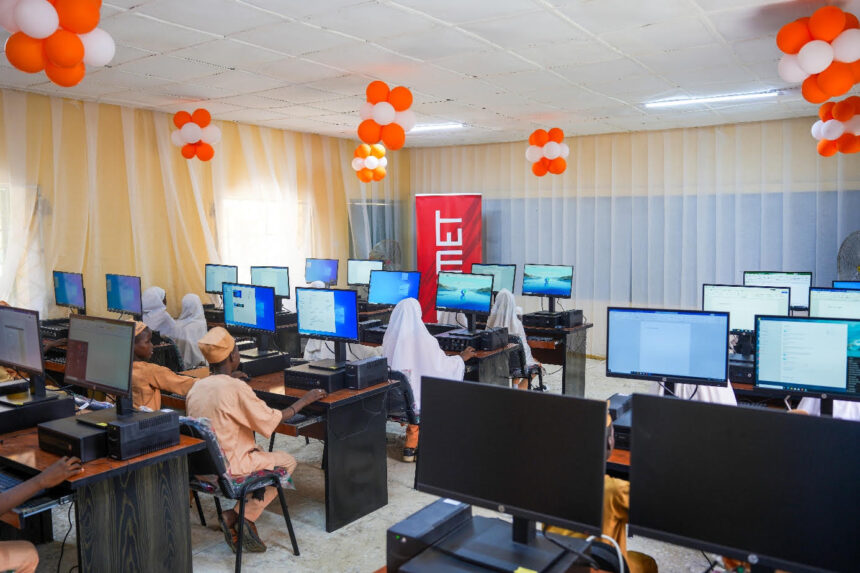
As part of its programme in investing in education and community development, one of Nigeria’s leading glass and aluminium solutions company, ABUMET, has donated a fully equipped digital learning centre to Race Course Model Primary School, Kano.
The initiative is which is part of ABUMET’s commitment to improving educational outcomes and helping young Nigerians acquire the digital skills needed to succeed in an increasingly technology-driven world, is aimed at giving hundreds of pupils’ access to modern technology and practical computer education.
To bring the project to life, ABUMET provided the school with 24 desktop computers, solar-powered electricity infrastructure, and new classroom furniture for both pupils and teachers.
The intervention is already creating a more conducive learning environment and introducing learners to hands-on computer education in ways that were previously difficult to achieve.
For many of the pupils, the facility represents a first meaningful encounter with digital technology, opening new possibilities for learning, creativity and future career development.

Speaking during the Corporate Social Responsibility (CSR) visit to the school, ABUMET General Manager, Diemo Schillack, said the project was inspired by the company’s desire to help bridge the digital divide and ensure that children are not left behind in the modern knowledge economy.
According to Scillack, exposure to technology at an early age can significantly influence a child’s educational journey, build confidence and create opportunities that extend far beyond the classroom. We believe every child deserves access to quality learning tools and the opportunity to develop skills that will prepare them for the future.
In the words of Schillack; “Technology is now part of everyday life, and introducing these young learners to digital tools early, gives them a stronger foundation for their education and future careers”.
The ABUMET General Manager expressed appreciation for the warm welcome received from the pupils and staff, describing their enthusiasm and excitement as inspiring.
Schillack reaffirmed the company’s commitment to supporting education and community development, saying that ABUMET plans to return within a year to assess the pupils’ progress and the impact of the learning centre.
In his response, the Head Teacher of Race Course Model Primary School, Salisu Alhassan, said the school’s digital learning programme was structured to ensure that pupils gain practical experience with the computers despite the school’s large enrolment.
Alhassan said; “We organise the pupils into smaller groups so that everyone has the opportunity to participate and learn, adding, this initiative goes beyond simply teaching children how to use computers. We want them to understand how technology can support learning, problem-solving and everyday life.
“On behalf of all stakeholders, we sincerely appreciate ABUMET for this remarkable contribution to our school,” Alhassan said. “The computers, solar power facilities and learning furniture will greatly improve teaching and learning, particularly in the area of digital literacy,” he said.

The head teacher further said that the pupils are already learning to use applications such as Microsoft Office while developing practical skills in writing, calculations, record-keeping and information management.
He also said that computer education has become more advanced from Primary Four to Primary Six, thus enable pupils to progressively build their digital competence before moving to secondary school.
Alhassan thanked ABUMET on behalf of the school’s management, teachers, pupils, parents and community stakeholders, describing the intervention as a transformative addition to the school’s educational resources.
Established in 1996, Race Course Model Primary School currently serves about 600 pupils across 14 classrooms, offering education from Early Childhood Care and Education (ECC) through Primary Six.
The school provides instruction in subjects including Mathematics, English Language, Basic Science, Basic Technology, Nigerian History, Arabic and Digital Literacy.
One of the most significant aspects of the project is the installation of a solar-powered energy system, which will provide reliable electricity for the computer centre.
It is expected that with consistent power supply, pupils will be able to access digital learning resources without the disruptions often associated with electricity challenges.
Beyond the immediate benefits to the school, the initiative highlights the important role that partnerships between the private sector and educational institutions can play in shaping the future of young Nigerians.
ABUMET said that by investing in digital education, it is helping to equip the next generation with the skills, knowledge and confidence needed to thrive in a rapidly evolving world.
For the pupils of Race Course Model Primary School, the new digital learning centre is more than a classroom filled with computers, but a gateway to new ideas, new opportunities and a brighter future where technology becomes a tool for learning, discovery and personal growth.