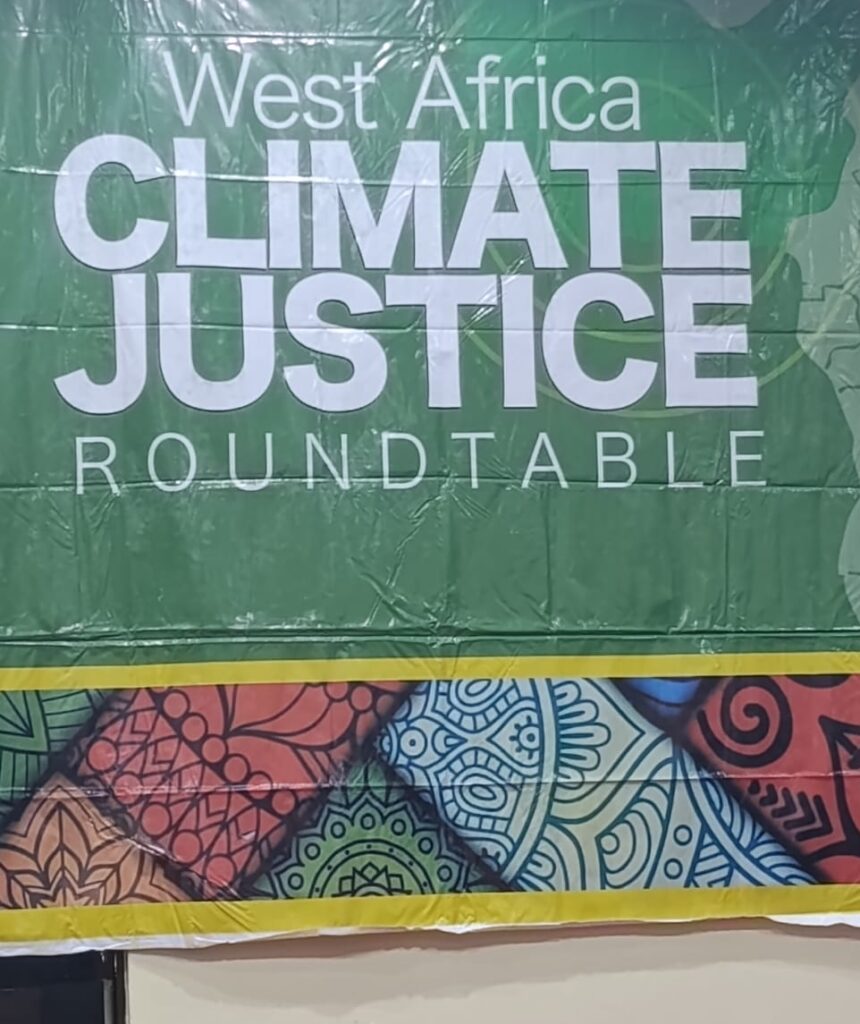
BY AMOS DUNIA, ABUJA – The West Africa Climate Justice Movement rose from an international conference in Abuja on Wednesday, July 15, 2026, and reaffirmed that achieving climate justice in West Africa requires transformative and systemic change that addresses the root causes of vulnerability while placing the rights, knowledge, and leadership of frontline communities at the centre of climate action.
Participants at the conference drawn from Burkina Faso, Ghana, Guinea, Mali, Nigeria, Togo and Sierra Leone underscored the importance of strengthening regional solidarity, deepening cross-border cooperation, and fostering inclusive partnerships to advance collective action toward a just, equitable, climate-resilient, and sustainable future.
The conference participants stated that in doing so, they renewed their shared commitment to safeguarding the well-being and aspirations of present and future generations across West Africa.
United by the conviction that West Africa’s shared climate challenges require a collective regional response, the participants noted that their convergence under a regional roundtable under the theme, “Building Solidarity for Climate Justice in West Africa”, brought together climate justice activists, civil society organisations, community representatives, youth and women leaders, and development partners to strengthen regional solidarity and advance a shared vision for climate justice rooted in equity, human rights, and community leadership.
In his keynote address, Professor Youba Sokona called for a united West African response grounded in justice, equity, sustainable livelihoods, inclusive development, and integrated approaches to energy, governance, finance, and industrial transformation.
Similarly, delegates from Burkina Faso, Ghana, Guinea, Mali, Nigeria, Sierra Leone, and Togo noted that West African communities are confronting interconnected climate and environmental crises that disregard political borders.
According to the participants; “From biodiversity loss and environmentally harmful extractive industries to pollution, food insecurity, and climate-induced displacement, demand a united regional response”.
The conference therefore called for stronger cross-border solidarity, policy alignment, community leadership, and the protection and integration of Indigenous knowledge as indispensable pillars of climate justice.
The roundtable also expressed concern over carbon markets, land and forest grabs, geo-engineering, and poorly governed green transition projects, warning that these threaten community rights, biodiversity, and environmental justice while delaying meaningful emissions reductions.
The participants noted that although West Africa contributes minimally to global greenhouse gas emissions, it however, suffers disproportionately from climate impacts, thus called for historical accountability through the fulfillment of climate finance commitments, recognition of climate debt, and equitable support and compensation for countries and communities protecting fossil fuel reserves and critical ecosystems.
The conference specifically called for a renewed commitment to stronger regional collaboration, coordinated advocacy, knowledge sharing, and community-led action to build a united West African climate justice movement founded on justice, equity, Indigenous knowledge, and ecological integrity.
A communique issued at the end of the Conference stated that climate crisis is driven by unsustainable production, consumption, and resource extraction, with its worst impacts falling on vulnerable communities that have contributed least to global emissions.
It also stated that West Africa faces escalating climate impacts including floods, droughts, desertification, coastal erosion, sea-level rise, and biodiversity loss that threaten food security, water resources, public health, livelihoods, and sustainable development.
The communique further stated; “Historical injustices, unequal global economic systems, and ongoing extractive activities continue to deepen Africa’s climate vulnerability, reinforcing the need for equity, differentiated responsibility, and respect for the rights of Indigenous Peoples and local communities.
“Climate justice is inseparable from human rights, including the rights to food, water, health, land, livelihoods, development, and a clean, healthy, and sustainable environment.
“False climate solutions, including poorly governed carbon markets and transition mineral projects, risk exacerbating environmental injustice, displacement, and resource exploitation where transparency, accountability, and the free, prior, and informed consent of affected communities are absent.
“Climate finance, particularly for adaptation, remains inadequate and inaccessible. In contrast, climate governance is constrained by weak implementation, limited accountability, and insufficient participation of women, youth, Indigenous Peoples, persons with disabilities, and other marginalized groups.
“Community-led adaptation, Indigenous and traditional knowledge, agroecology, ecosystem restoration, and other locally driven resilience approaches are among the most effective climate responses but remain underfunded and under-recognized.
“Achieving energy sovereignty through affordable, reliable, and sustainable energy systems, supported by local value addition, technology transfer, and domestic industrial development, is essential for a just transition.
“Stronger regional cooperation and partnerships among governments, civil society, communities, academia, labour, faith-based organizations, and development partners are critical for coordinated advocacy, knowledge sharing, and effective climate action across West Africa.
“Transformative reforms in global climate governance, finance, technology transfer, debt architecture, and development frameworks are essential to advance climate justice, guided by the principles of equity, solidarity, stewardship, and intergenerational responsibility,” it stated.
The conference participants thereafter resolved to strengthen the West African Climate Justice Movement as a permanent, people-centred platform for regional solidarity, collective organizing, coordinated advocacy, knowledge sharing, research, and action, while setting a common agenda for ECOWAS, the African Union, and Global South movements.
The participants noted that Map, strengthen, and leverage existing movements, initiatives, networks, and people’s knowledge across the region including platforms such as the World Social Forum, the Niger Delta Climate Change Platform, and the African Women Climate Justice to amplify collective advocacy, build solidarity, consciously deploy existing human resources, and engage governments, regional institutions, and other stakeholders in driving transformative climate action and systemic change.
They also resolved to promote cultural diversity by leveraging Africa’s linguistic diversity as an opportunity to deepen climate consciousness, strengthen cross-border solidarity, and enhance public engagement, while promoting cultural values and practices that reduce vulnerabilities, foster resilience, and enable community expression.
The conference further resolved to advocate for rights-based climate governance that integrates climate justice, human rights, gender equality, equity, sustainability, and intergenerational justice into national and regional policies through inclusive, transparent, and participatory decision-making.
Other resolutions reached at the Abuja conference include; “Promote a just energy transition by accelerating community-centred renewable energy development, supporting locally owned clean energy solutions, and phasing out fossil fuel expansion and environmentally destructive extractive activities.
“Demand international climate accountability through adequate grant-based climate finance, technology transfer, capacity strengthening, effective implementation of the Loss and Damage Fund, and direct support for frontline and climate-affected communities.
“Reject false climate solutions, including harmful carbon markets, while advancing biodiversity conservation, ecosystem restoration, food sovereignty, agroecology, and people-centred, nature-positive development.
Strengthen environmental governance by ensuring transparency, accountability, the polluter pays principle, Free, Prior and Informed Consent (FPIC), equitable benefit-sharing, and effective enforcement of environmental laws and safeguards.
“Protect civic space and environmental defenders while guaranteeing the meaningful participation and leadership of Indigenous Peoples, women, youth, local communities, persons with disabilities, and civil society in climate decision-making at all levels.
“Establish a rotational leadership structure and invest in Africa’s youthful population, research, innovation, and Indigenous knowledge systems by mapping and leveraging community knowledge, strengthening evidence-based advocacy, and advancing locally led climate solutions and regional learning.
“Build resilient communities by supporting community-led adaptation, renewable energy, sustainable livelihoods, ecosystem restoration, and coordinated regional advocacy in regional and global climate processes, including the UNFCCC.
Promote regional environmental restoration and collective action by institutionalizing an annual tree-planting campaign across West Africa as a symbol of solidarity, ecological restoration, climate resilience, and community participation”.
The Conference also reaffirmed that achieving climate justice in West Africa requires transformative and systemic change that addresses the root causes of vulnerability while placing the rights, knowledge, and leadership of frontline communities at the centre of climate action.