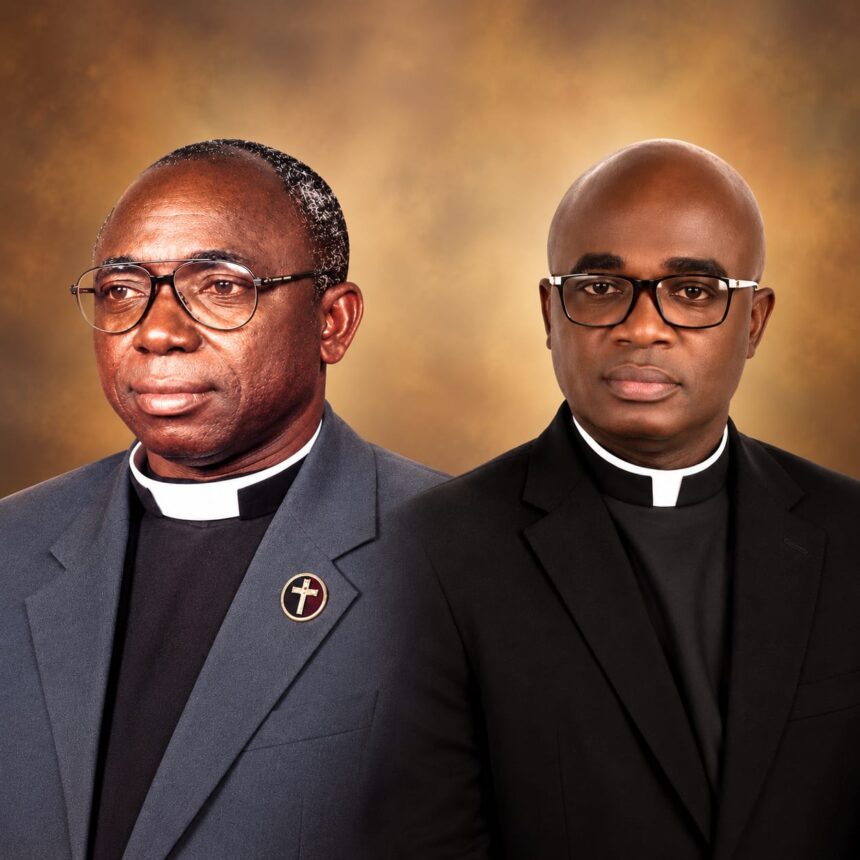
”Adasu governed for just a few months and laid significant institutional foundations; Alia, now in his third year, is pursuing a broader programme of renewal across infrastructure, education, healthcare, agriculture and industrialization”.
BY TERSOO KULA
Benue State, since its creation over 50 years ago, has produced two Catholic priests as governors. The first was the late Rev. Fr. Moses Orshio Adasu. He was Benue’s second civilian governor. He assumed office in January 1992, and barely 18 months into his tenure, he, like other governors across the country, was forcefully removed following the military takeover of November 1993.
Despite his brief stay in office, his administration left lasting legacies. These include the establishment of the first state owned university in Nigeria’s North, the Benue State University. He went on to establish the College of Education, Oju; founded the J. S. Tarka Foundation; and pursued industrialisation, including the establishment of BENCO Roof Tiles Company at Abinsi in 1992, alongside many other projects that were underway.
His greatest enduring legacies remain the university and the College of Education. It is therefore not a mere jamboree that the university was subsequently renamed Father Adasu University, Makurdi.
This institution has continued to shape the state’s educational landscape decades after his demise, producing no fewer than 50,000 graduates, many of whom are contributing immensely to nation building and leading in their various fields of specialization.
The university’s subsequent development into a major institution of higher learning remains among the most enduring legacies associated with his administration. By a wide margin, the institution is the most enduring legacy project since the creation of Benue State in 1976.
Other administrations came after the era of the late Adasu, many years after state allocations had been boosted, but none of these successive administrations can beat their chests and claim to have gone shoulder-to-shoulder with the 18 months of the priest who joined politics to serve his people.
Many years after a large circle of recycled career politicians had held sway, another Roman Catholic priest, Rev. Fr. Hyacinth Iormem Alia, emerged as governor. Alia’s administration has proven to be very intentional about building on that institutional foundation while extending the frontiers of development to new horizons.
The establishment of Father Adasu University’s Faculty of Engineering at Adikpo, Kwande Local Government Area, expands specialised higher education beyond Makurdi. The Reverend Gentleman, like Adasu, has established Benue State University of Agriculture, Science and Technology, Ihugh. The first state-owned specialised university of its kind in the North has matriculated its first batch of students into its various faculties.
Where Adasu laid an important foundation in higher education, Alia is pursuing expansion and specialisation to connect learning with agriculture, science, technology and economic growth.
Governor Alia has embarked on an ambitious infrastructure programme, completing more than 50 intra-city roads, constructing over 370 kilometres of rural roads and completing interchanges at High Level in Makurdi and in Gboko.
His administration has also completed the Achusa-Idye-Wurukum drainage canal, dualised major roads and introduced solar-powered street lighting through Light Up Makurdi and other urban centres across the state’s 23 local government areas. These interventions seek to improve mobility and security, address flooding and modernise communities.
Thirty-four years ago, Governor Adasu pursued industrial development through initiatives such as BENCO Roof Tiles. Today, Governor Alia is targeting the revival of moribund enterprises and agro-allied manufacturing through the Benue Investment and Property Company. The Bensono fruit concentrate plant was commissioned in June 2026, while Taraku Mills has commenced test production.
The administration has also established the Food Basket Brewery. At Taraku Mills, the previously considered insurmountable challenges, including legal claims running into billions of naira, huge financial obligations owed to former staff and many other obstacles, have been addressed. The company has been rehabilitated and production trials have been restored.
The larger ambition is to transform Benue’s agricultural wealth into local manufacturing, jobs and sustainable economic opportunities.
In education, Alia’s administration has breathed life back into the elementary education system by recruiting no fewer than 9,700 primary-school teachers and upgrading school infrastructure, with no fewer than 444 structures improved across the state. It has also introduced free basic education from Basic One to Basic Nine and launched BRACE-UP to bring out-of-school children back into classrooms. The administration also paid public-school students’ examination fees during the 2023/2024 academic session.
In workers’ welfare, the administration has implemented a N75,000 minimum wage, paid inherited salary arrears, approved long-delayed promotions and introduced payroll reforms. The Nigeria Union of Teachers’ endorsement of the governor ahead of the 2027 general elections further highlighted the administration’s interventions in education and teachers’ welfare.
Healthcare has received similar attention. The administration has improved facilities at Benue State University Teaching Hospital (BSUTH), expanded services at the Muhammadu Buhari Mother and Child Hospital and committed N2 billion towards a cancer treatment centre.
On October 9, 2026, Governor Alia released N2.3 billion to BSUTH to address outstanding arrears. He also reviewed allowances and annual increments and approved the 2026 promotion exercise.
Agriculture has also featured through subsidised fertiliser, the provision of tractors, support for community farming, efforts to revive the Yandev integrated swine and crop project, and plans to develop Ikyogen Cattle Ranch.
Adasu and Alia therefore represent two chapters in Benue’s search for purposeful governance. Adasu demonstrated that a short tenure could produce institutions of lasting value; Alia is seeking to translate a broader development agenda into tangible improvements in infrastructure, public services and productive capacity.
Their records do not suggest that priests are automatically superior leaders, but they decisively refute the notion that priesthood disqualifies anyone from governing.
The ultimate test of leadership is not the collar a man once wore or still wears, the political party he belongs to or the powerful individuals who celebrate him. It is whether children receive quality education, communities enjoy accessible roads, workers are paid when due, hospitals provide effective care and institutions endure for generations.
Benue is blessed in the hands of priests when their calling to serve humanity finds expression in responsible leadership, enduring institutions and measurable public value. Adasu laid the foundations; Alia is pursuing expansion. Both remind us that leadership must ultimately be judged by what it delivers to the people.
There is something profoundly remarkable about the place of these two Catholic priests, Very Rev. Fr. Dr. Moses Orshio Adasu and Rev. Fr. Dr. Hyacinth Iormem Alia, in the political and developmental history of Benue State.
Separated by more than three decades, their administrations demonstrate how purposeful leadership can translate a calling to serve humanity into enduring public value.
Adasu governed for just a few months and laid significant institutional foundations; Alia, now in his third year, is pursuing a broader programme of renewal across infrastructure, education, healthcare, agriculture and industrialisation. Their records challenge the prejudice that priesthood is incompatible with political leadership.
In conclusion, it is indeed safe to say that Benue is blessed in the hands of priests.
…Sir Tersoo Kula is the Chief Press Secretary to the Governor of Benue State.