BY COBHAM NSA – Nigeria’s Tax-to-Gross Domestic Product (GDP) ratio has surged from seven percent to 12.5 percent, marking a dramatic fiscal turnaround that hands the government massive leverage to fund public projects.
Minister of Finance and Coordinating Minister of the Economy, Taiwo Oyedele, disclosed this explosive economic growth on the sidelines of the 2026 IMF and World Bank Group Annual Meetings in Bangkok, Thailand.
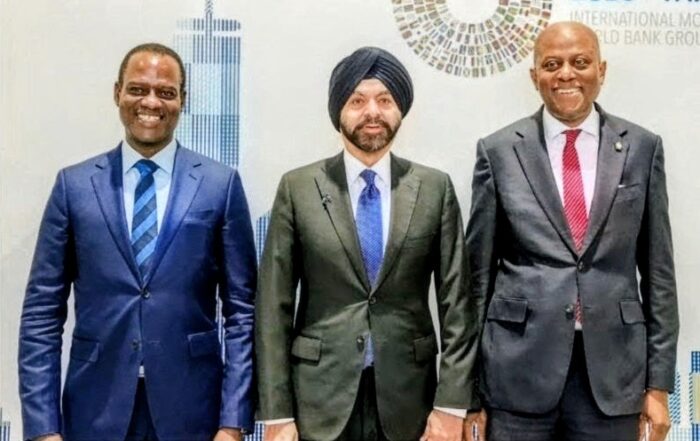
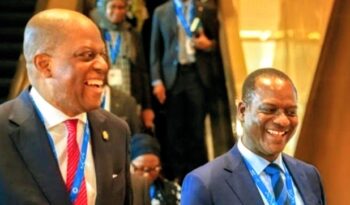
Oyedele, who spoke when he met the President of the World Bank Group, Ajay Banga, alongside Governor of the Central Bank of Nigeria (CBN), Olayemi Cardoso, noted that the spike provides a critical buffer for the nation’s finances.
He explained that with this newfound revenue, the government can now aggressively fund public investments, completely eliminating the need to print money or rely on toxic deficit monetisation.
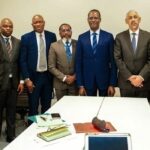
Leading Nigeria’s delegation to the meeting which reviewed Nigeria’s reform progress, the Finance Minister said the next phase of its agenda is focused on turning macro-economic stability into faster growth, more private investment and stronger domestic revenues.
Pitching Nigeria’s next economic chapter to global investors, the meeting discussed how the country can make greater use of World Bank guarantee instruments, in a manner that they can unlock financing for infrastructure and draw more private capital into the domestic market.
Additionally, power infrastructure and human capital were identified as priorities for continued public investment, given their importance to business competitiveness, productivity and job creation, just as the meeting also emphasized on the need for improved quality of public spending, so that each Naira delivers measurable economic and social returns.
In his remarks at the meeting, World Bank President Ajay Banga strongly endorsed the momentum being recorded in the economic space, highlighting Nigeria’s dramatic turnaround in investor confidence.
Anchoring his praise, Banga pointed to a massive metric of success: private capital inflows into Nigeria skyrocketed from a meager $300 million in 2023 to nearly $6 billion in 2026, a stunning twentyfold increase.
He praised the progress of Nigeria’s reforms, pointing to the rise in private capital inflows from about $300 million in 2023 to nearly $6 billion in 2026, a twentyfold increase.
The meeting discussed how Nigeria can make greater use of World Bank guarantee instruments. These guarantees can unlock financing for infrastructure and draw more private capital into the domestic market.
Power infrastructure and human capital were identified as priorities for continued public investment, given their importance to business competitiveness, productivity and job creation. The meeting also stressed the quality of public spending, so that each naira delivers measurable economic and social returns.
The meeting is part of the Federal Government’s wider engagement with development partners to lock in reform gains and attract new investment. As Nigeria moves from stability to growth, the priority is to turn stronger fundamentals into productive investment, more jobs and better living standards for Nigerians.
Offering deeper insight on the meeting, a statement by the Head of Media, Federal Ministry of Finance, Efe Ovuakporie said it focused heavily on shifting Nigeria’s hard-won macroeconomic stability into tangible outcomes.
Importantly, the delegation outlined a three-pronged agenda for the next phase of reforms: Spurring faster economic growth across key sectors; Aggressively driving private investment into the country; and Building stronger domestic revenues to reduce debt reliance.