- Insist it was only an expression of concern, reservation
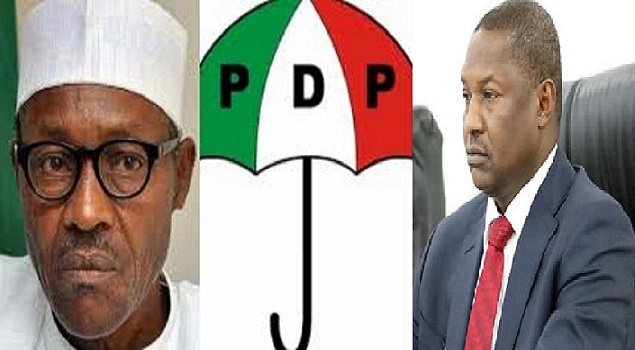
BY SEGUN ADEBAYO – With disputations yet to abate over the contentious section 84 (12) of the amended Electoral Act 2022, President Muhammadu Buhari has denied ordering the Senate to remove it from the statute books as widely reported in the public space.
The President told a Federal High Court sitting in Abuja that contrary to claims by the Peoples Democratic Party (PDP) in a suit instituted against him and 12 others on the Electoral Act, his position was only an expression of reservations and concerns over that aspect of the amended Electoral Act.
This denial was contained in a joint counter-affidavit filed at the instance of the Attorney General of the Federation (AGF) and Minister of Justice, Abubakar Malami, who explained that on February 25, 2022, the President gave proper, full, and unconditional assent to the amended Electoral Act.
Filed on their behalf by a Senior Advocate of Nigeria (SAN), Oladipupo Okpeseyi, and deposed by a legal practitioner, Abimbola Akintola, the counter-affidavit said PDP’s claims against them on the Electoral Act are totally false and replete with gross untruths aimed at misleading the court to favour it with the ruling.
The counter-affidavit read in part “The assent of the 1st defendant (Buhari) to the Electoral Bill given on February 25, 2022, was proper, full and unconditional. The 1st defendant (Buhari) assented to the Electoral Bill 2022 on February 25 but did not give conditions or directives to the National Assembly in the manner erroneously deposed to by the plaintiff (PDP).
“At no time did the 1st defendant (Buhari) give any directive to the management or leadership of the National Assembly as regards the removal of section 84 (12) of the Electoral Act 2022; from the Act.
“Prior to assenting to the Electoral Bill 2022, the 1st defendant (Buhari) merely expressed his observations and concerns about the constraints of section 84 (12) of the Bill on serving public office holders and political appointees but gave his assent to avoid further delay as time was of the essence.
“That the 1st defendant (Buhari) merely expressed his views not only to the National Assembly but to the entire nation as regards the inconsistency of section 84 (12) of the Electoral Act with other provisions of the Constitution.
“On March 8, 2022, 1st defendant (Buhari) officially wrote Senate President and House of Representatives Speaker to express his concerns about section 84 (12) of the Electoral Act and formally requested for the amendment to be effected on the section so as to eliminate the area of infraction with the Constitution.
“That I am aware that the National Assembly neither accepted nor acted on the opinion or suggestion of Buhari. In this instance, 1st and 2nd defendant, (Buhari and Malami) truly and firmly believe that section 84 (12) of the Electoral Act disenfranchises and discriminates against Nigerians in public service or public office holders who are political appointees and prevent them from engaging in the electoral process in the exercise of their inalienable rights in a participatory democracy.
“That Buhari and Malami have never taken it upon themselves to declare section 84 (12) or any provisions of the Electoral Act unconstitutional as such is beyond their constitutional power.
Additionally, both defendants also claimed in the counter-affidavit that a Federal High Court in Abia State had in March 2022, through a judgment by Justice Evelyn Anyadike, struck down the section and ordered it to be deleted forthwith for being inconsistent with the Constitution.
They also said both the National Assembly and PDP have since appealed the judgment, adding that it is only the Court of Appeal that can restore the section into the Electoral Act and not any High court.
Further arguing that the PDP suit has become academic and constituted an abuse of the Court process on the strength of the pending Court of Appeal matter, the defendants urged the court to dismiss the suit, noting that PDP should not be allowed to take over the functions of the National Assembly since it has no power to amend or enact laws.
The counter-affidavit also stated that the PDP would suffer no harm if the contentious section is deleted, adding that taking out the section will deepen the practice of democracy and stop discrimination against public servants and public officeholders.
It is on record that the Federal High Court in Abuja, presided over by Justice Inyang Eden Ekwo, had on March 7, 2022, stopped President Buhari, AGF and the Senate President from tinkering with the newly amended Electoral Act 2022, as he ruled on an ex-parte application brought before it by the PDP.
Justice Ekwo had expressly restrained all the defendants in the suit from tampering with section 84 (12) of the Electoral Act or preventing it from being implemented for the purpose of the 2023 general elections.
Contents
BY SEGUN ADEBAYO – With disputations yet to abate over the contentious section 84 (12) of the amended Electoral Act 2022, President Muhammadu Buhari has denied ordering the Senate to remove it from the statute books as widely reported in the public space.The President told a Federal High Court sitting in Abuja that contrary to claims by the Peoples Democratic Party (PDP) in a suit instituted against him and 12 others on the Electoral Act, his position was only an expression of reservations and concerns over that aspect of the amended Electoral Act.This denial was contained in a joint counter-affidavit filed at the instance of the Attorney General of the Federation (AGF) and Minister of Justice, Abubakar Malami, who explained that on February 25, 2022, the President gave proper, full, and unconditional assent to the amended Electoral Act.Filed on their behalf by a Senior Advocate of Nigeria (SAN), Oladipupo Okpeseyi, and deposed by a legal practitioner, Abimbola Akintola, the counter-affidavit said PDP’s claims against them on the Electoral Act are totally false and replete with gross untruths aimed at misleading the court to favour it with the ruling.The counter-affidavit read in part “The assent of the 1st defendant (Buhari) to the Electoral Bill given on February 25, 2022, was proper, full and unconditional. The 1st defendant (Buhari) assented to the Electoral Bill 2022 on February 25 but did not give conditions or directives to the National Assembly in the manner erroneously deposed to by the plaintiff (PDP).“At no time did the 1st defendant (Buhari) give any directive to the management or leadership of the National Assembly as regards the removal of section 84 (12) of the Electoral Act 2022; from the Act.“Prior to assenting to the Electoral Bill 2022, the 1st defendant (Buhari) merely expressed his observations and concerns about the constraints of section 84 (12) of the Bill on serving public office holders and political appointees but gave his assent to avoid further delay as time was of the essence.“That the 1st defendant (Buhari) merely expressed his views not only to the National Assembly but to the entire nation as regards the inconsistency of section 84 (12) of the Electoral Act with other provisions of the Constitution.“On March 8, 2022, 1st defendant (Buhari) officially wrote Senate President and House of Representatives Speaker to express his concerns about section 84 (12) of the Electoral Act and formally requested for the amendment to be effected on the section so as to eliminate the area of infraction with the Constitution.“That I am aware that the National Assembly neither accepted nor acted on the opinion or suggestion of Buhari. In this instance, 1st and 2nd defendant, (Buhari and Malami) truly and firmly believe that section 84 (12) of the Electoral Act disenfranchises and discriminates against Nigerians in public service or public office holders who are political appointees and prevent them from engaging in the electoral process in the exercise of their inalienable rights in a participatory democracy.“That Buhari and Malami have never taken it upon themselves to declare section 84 (12) or any provisions of the Electoral Act unconstitutional as such is beyond their constitutional power.Additionally, both defendants also claimed in the counter-affidavit that a Federal High Court in Abia State had in March 2022, through a judgment by Justice Evelyn Anyadike, struck down the section and ordered it to be deleted forthwith for being inconsistent with the Constitution.They also said both the National Assembly and PDP have since appealed the judgment, adding that it is only the Court of Appeal that can restore the section into the Electoral Act and not any High court.Further arguing that the PDP suit has become academic and constituted an abuse of the Court process on the strength of the pending Court of Appeal matter, the defendants urged the court to dismiss the suit, noting that PDP should not be allowed to take over the functions of the National Assembly since it has no power to amend or enact laws.The counter-affidavit also stated that the PDP would suffer no harm if the contentious section is deleted, adding that taking out the section will deepen the practice of democracy and stop discrimination against public servants and public officeholders.It is on record that the Federal High Court in Abuja, presided over by Justice Inyang Eden Ekwo, had on March 7, 2022, stopped President Buhari, AGF and the Senate President from tinkering with the newly amended Electoral Act 2022, as he ruled on an ex-parte application brought before it by the PDP.Besides agreeing with the PDP that the Electoral Act having been assented to by Buhari has become a valid law and cannot be tampered with without following due process of law, Justice Ekwo also acknowledged the submissions by Chief James Ogwu Onoja (SAN), counsel to PDP, that the proper and fit place to challenge the validity of any existing law or the Electoral Act is a court of competent jurisdiction.In continuation of the legal fireworks, the Court has fixed May 16, 2022, for hearing in the suit marked FHC/ABJ/CS/ 247/2022.