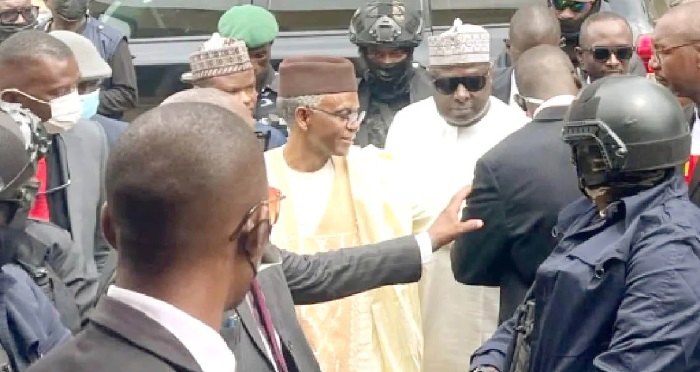
BY OUR CORRESPONDENT – A Kaduna State High Court on Tuesday cleared the way for a Department of State Services (DSS) digital forensic expert to testify against former Governor Nasir El-Rufai, while adjourning the alleged multi-billion Naira misappropriation trial to November 30 and December 1 for continuation.
Presiding Judge Justice Darius Khobo dealt a blow to El-Rufai’s defence team on Tuesday, overruling their fierce objections to the testimony of subpoenaed forensic expert Shegun Kayode. The defence had aggressively fought to block Kayode, arguing his name and evidence summary were missing from the official prosecution witness list.
Justice Khobo ruled that the objection notwithstanding, the prosecution holds the right to call the forensic specialist, adding that the high-stakes trial will now resume late next month for a grueling cross-examination of the DSS expert’s digital findings. However, the judge held that the defence’s right to a fair hearing could be protected by allowing it to cross-examine the witness.
The ruling followed an objection by El-Rufai’s senior counsel, Paul Erokoro (SAN), who argued that the defence had not received the witness’s evidence summary or the subpoena, saying the omission denied the defence adequate notice to prepare for the cross-examination and understand the case it was required to answer.
However, putting forward his argument, counsel to the Independent Corrupt Practices and Other Related Offences Commission (ICPC), Ayodele Adedipe, said failure to include a subpoenaed witness in the proof of evidence did not automatically make the testimony inadmissible.
After listenting to both parties, Justice Khobo confirmed that the witness had been subpoenaed through an order signed by the court on June 30, 2026 and further ruled that the defence could address its concerns about fair hearing through cross-examination.
Led in evidence by the ICPC counsel, Kayode informed the court that the DSS conducted a forensic examination of communication records and audio recordings allegedly linked to El-Rufai and some associates at the request of the ICPC, explaining that the exercise followed a formal request from the anti-graft commission and approval by the DSS’ Director-General.
He said specialised software revealed two-way communications involving El-Rufai, his brother and another person between October 25 and 28, 2025, adding that the initial findings prompted further analysis of audio recordings obtained from a communication intelligence server.
According to Kayode, the DSS telecommunications intelligence unit provided the call data records through a secure server in line with the service’s procedures for preserving electronic evidence. He told the court that his team made four duplicate copies of the original audio recording while preserving the original to protect the integrity of the evidence.
Offering an insight of the process, he said the examination involved analysing vocal characteristics, background noise and electromagnetic interference, adding that the results indicated the audio originated from a human voice in a natural environment rather than being artificially generated.
Additionally, he said biometric voice analysis was conducted using another forensic tool to examine the speaker’s voice, and the recording allegedly contained a conversation between El-Rufai and his elder brother about plans to liquidate a company, Singularity, halt an ongoing Economic and Financial Crimes Commission (EFCC) case involving the company and prevent an investigation into another company, IHS.
He further alleged that the conversation referred to $500,000 and $100,000 purportedly set aside to settle EFCC officials and an intermediary. These claims formed part of the witness’s account of the forensic findings and have yet to be established by the court, even as Kayode acknowledged preparing a detailed forensic investigative report and submitting it to the court as evidence.
But objecting to the tendering of the document, El-Rufai’s counsel, Erokoro argued that the prosecution could not introduce additional evidence through a subpoenaed witness without following the appropriate legal procedure.
In his response, the prosecuting counsel described the objection as unfounded, arguing that the court had earlier ruled that evidence from a subpoenaed witness did not necessarily have to be included in the proof of evidence.
After hearing arguments from both parties, Justice Khobo overruled the objection and allowed Kayode to continue his testimony, urging the defence to obtain a certified true copy of the evidence through the court’s registry.
The former Governor is facing a fierce legal battle as the ICPC prosecutes him on a sweeping nine-count charge of corruption and abuse of office, alleging a massive betrayal of public trust during his eight-year tenure from May 2015 to May 2023.
With his time as chief executive now turning into the center of a high-stakes criminal investigation, at the heart of the prosecution’s explosive case is the phantom N11 billion light rail project with the Commission further claiming that El-Rufai actively manipulated the state government into releasing the staggering sum to an entirely unregistered entity for a transit system that was never built.
Alluding to the gravity of the charges, investigators claim the embattled former governor lined his own pockets by approving and receiving a massive N289.8 million severance allowance, a payout that dwarfs the N20 million he was legally entitled to, allegedly conferring a corrupt advantage on himself.
However, El-Rufai is digging in for a fierce defence and has categorically denied every allegation leveled against him, setting the stage for a dramatic courtroom showdown as he fights to clear his name and salvage his political legacy.