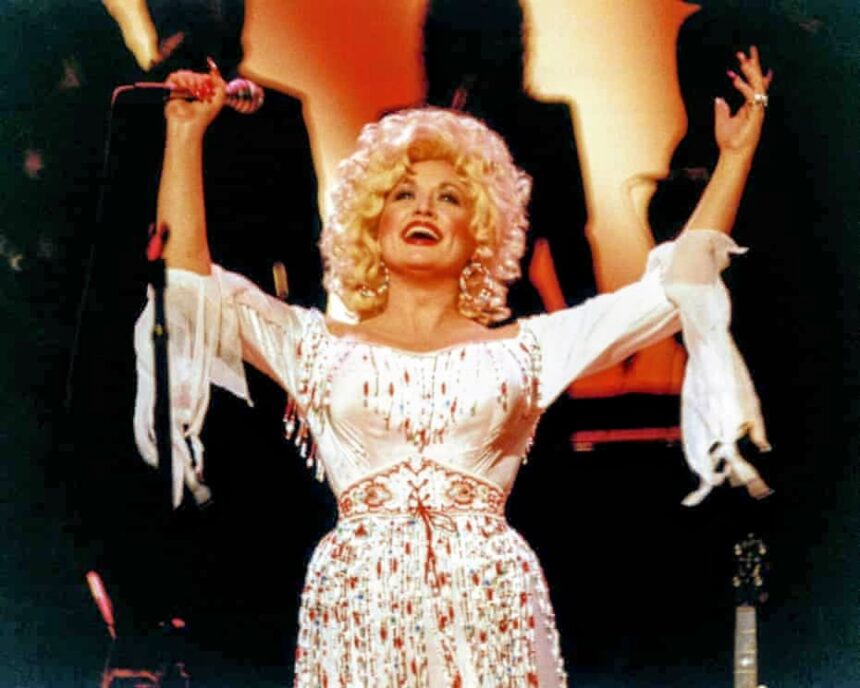
“Her greatness was undisputed and there were no dissenting voices or off-key choruses. Dolly Parton gave us a coat of many colours, but we can improve on it by ensuring that no child is deprived of proper clothing”.
BY OWEI LAKEMFA

Dolly Rebecca Parton-Dean taught the world that poverty is not a reproach. Not a DNA or a sin. In fact, that it can be a badge of honour worn with pride.
In her 1971 classic “Coat of Many Colours” she stitched a true story of poverty with the Biblical story of Joseph and presented humanity unforgettable lyrics. The “coat” was a biblical story of love, preference and anointment. But the Parton coat was parchment sewn with love and worn proudly by a child. Although the coat was sewn from rags with patches on her britches and holes in her shoes, the child could not see her odd appearance. When her mates laughed at her, she recalled the love with which her mother sewed the coat, went on the offensive and tried to turn the tables. She told her schoolmates that the rags she wore were “worth more than all their clothes.”
She then moved from the psychological offensive to philosophical grounds. She posited: “That one is only poor only if they choose to be.” This in reality is not correct, as poverty is an economic reality, and one is not poor out of choice but because of varied factors, especially the prevalent socio-economic system. In other words, poverty is not a democratic choice but an imposition, as it is unusual for anyone to choose poverty. The rare cases in history include Prince Siddhartha Gautama (the Buddha), who abandoned royal riches to live the life of a mendicant, and St Francis of Assisi, who for religious reasons renounced his family wealth to embrace poverty.
For Parton, her riches were psychological, as she confessed: “Now I know we had no money but I was rich as I could be in my coat of many colors my mama made for me made just for me.” The point she made is that material possessions are not really wealth. Rather, wealth is living for others, making or leaving the world a better place. Her way of doing so was philanthropy: giving out as much as she could, fighting childhood illiteracy through her Imagination Library programme, rolling out the Dolly Parton Scholarship and contributing to various life-sustaining projects like hospitals.
When she rose from rags to riches, she never forgot the depths from which she had risen, and a number of her songs reminded humanity of the poverty-ridden world we live in. Her “Coat of Many Colours” may be the most famous, but there are other classics like “Daddy’s Working Boots” and “9 to 5” about the resilience of working people. There is also “Poor Folks Town,” where, like the “Coat,” there was a shortage of money but plenty of love. In “My Tennessee Mountain Home” she celebrated nature and peaceful rural life: “In my Tennessee mountain home life is as peaceful as a baby’s sigh. In my Tennessee mountain home crickets are singing in the fields nearby.”
I find Parton one of the most combative and resilient guerrilla fighters who knows how to wear out her enemies and psychologically defeat them. In “Jolene” she employed these tactics. In a fight for the soul of a lover, she presented herself as very weak and quite vulnerable: “I’m begging of you please don’t take my man (Jolene) Jolene, Jolene, Jolene, Jolene please don’t take him just because you can.”
She humours her rival: “Your beauty is beyond compare with flaming locks of auburn hair, with ivory skin and eyes of emerald green (Jolene). Your smile is like a breath of spring. Your voice is soft like summer rain, and I cannot compete with you, Jolene (Jolene).”
Then she presented herself as a supplicant who is damned unless her rival is magnanimous: “You could have your choice of men but I could never love again. He’s the only one for me, Jolene (he’s the only one). I had to have this talk with you. My happiness depends on you and whatever you decide to do, Jolene.”
However, in doing this she presents her rival as a free, unreliable and untrustworthy woman who could have her choice of men.
She then makes a soulful final plea: “Please don’t take him just because you can (just because you can) Jolene (please don’t take him, please don’t take him) Jolene Jolene (Jolene) Jolene. He’s the only one for me, Jolene.”
In my view, Jolene was already defeated and needed to go after other men to conquer since she “could have her choice of men.”
In another psychological warfare, she entraps a would-be lover. In “The Bargain Store” she told him: “My life is likened to a bargain store and I may have just what you’re looking for. If you don’t mind the fact that all the merchandise is used, with a little mendin’ it could be as good as new. Why you take for instance this old broken heart. If you will just replace the missing part you would be surprised to find how good it really is. Take it and you never will be sorry that you did.” So, it is a guaranteed life purchase from which there will be no regret. However, despite such seeming meekness and submissiveness of the Parton woman, lies a heart of strong resolve.
In “I Will Always Love You” she takes a tough decision having reached the conclusion: “If I should stay well I would only be in your way, and so I’ll go, and yet I know that I’ll think of you each step of my way.”
To her, it was a reluctant break but one that had to be made: “Bitter-sweet memories, that’s all I have and all I’m taking with me. Good-bye, oh, please don’t cry, cause we both know that I’m not what you need.” In this case, it was the ability of the woman to face reality and that love is not all that is needed.
Parton was a beautiful storyteller, writer and composer with ten Grammy Awards from fifty-five nominations. Her songs transcended generations and will transcend more. On August 25, 2026, Dolly, at 80, stopped singing for mortals. She had done her bit and bequeathed us wealth we never asked for and may not really deserve. In death, the world stood up for her. Her greatness was undisputed and there were no dissenting voices or off-key choruses. Dolly Parton gave us a coat of many colours, but we can improve on it by ensuring that no child is deprived of proper clothing. The world is rich enough to guarantee every child the right to clothing, shelter, food, basic healthcare and education. Collectively, we have the resources to abolish poverty. This is the duty we owe Dolly Parton.