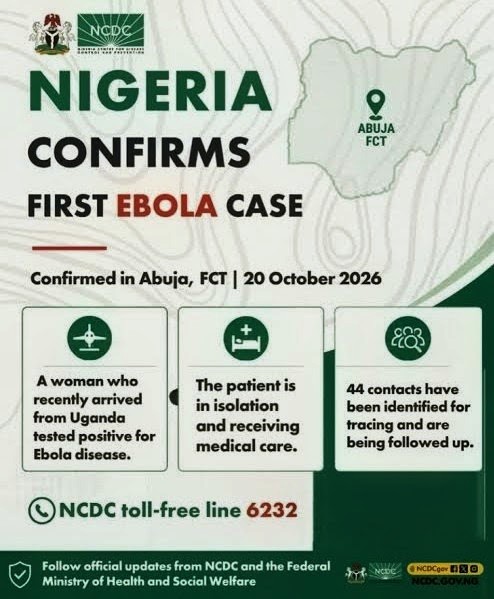
BY EDMOND ODOK – Nigeria has moved into high alert locking down contact tracing for 44 identified individuals following the confirmation of an imported case of the lethal Bundibugyo ebolavirus in the Federal Capital Territory (FCT)
In a swift, decisive move to protect citizens, public health emergency measures have been fully activated across the nation’s capital to contain the threat and prevent any further spread.
Coordinating Minister of Health and Social Welfare Professor Muhammad Pate announced the emergency deployment during a media briefing in Abuja, stressing that swift medical isolation and aggressive tracing have already fenced in the threat.
Prof Pate said government acted swiftly following laboratory confirmation of the infection on October 20 with the Health Ministry deploying elite rapid-response teams to isolate the case, initiate aggressive contact tracing, and fortify frontline medical facilities.
He said the containment strategy is moving at maximum velocity, leveraging the country’s robust public health architecture to neutralize the risk before it escalates, reassuring the public that the government is acting with absolute transparency and speed.
The Minister explained that health authorities are working in lockstep with international partners and local agencies to lock down the infection vector, adding that the clear and important message from the government is immediate response, the containment protocol is airtight, and every resource is being deployed to guarantee national biosecurity.
Pate disclosed that the patient, a woman who recently arrived in Nigeria on an international flight from Uganda, was currently in isolation and receiving medical care.
The Minister, who described the case as “a contained case,” assured Nigerians that the government was working with relevant authorities and partners to prevent further transmission, adding the the identified woman had been admitted to a private hospital in the FCT, where she received care for several days before the diagnosis was confirmed.
He said contact tracing had commenced, with 44 close contacts identified so far, while public health teams were identifying and monitoring people who might have been exposed, including healthcare workers, patients, caregivers and travel contacts.
“Surveillance has also been intensified, and the private hospital where the patient was treated is receiving immediate support to strengthen infection prevention and control measures,” he said.
The minister urged public and private healthcare facilities nationwide to remain on high alert, maintain a high index of suspicion, promptly identify and isolate suspected cases.
He also urged the public to observe strict infection prevention and control measures, and immediately report suspected cases to public health authorities.
He said Ebola spreads through direct contact with the blood or body fluids of an infected person who is sick or has died from the disease, as well as contact with contaminated materials.
Urging Nigerians to practise regular hand hygiene, avoid contact with the body fluids of anyone suspected to have Ebola and watch for symptoms, Prof Pate said the symptoms include fever, severe weakness, headache, vomiting and diarrhoea, particularly following possible exposure.
According to him, people who might have been exposed should report immediately, even if they felt well, while anyone who developed symptoms should avoid close contact with others and call public health authorities for guidance before visiting a healthcare facility.
Additionally, he said those contacted during the tracing exercise, including relevant airline passengers, should provide the required information and comply with public health advice.
However, while cautioning against rumours, misinformation and stigmatisation, the Minister urged Nigerians to always rely on verified information from official health authorities.
Prof Pate, who recalled that Nigeria had successfully contained Ebola in 2014, said the CV country has the experience and public health systems required to respond to the current case.
But stressing that containing the infection required cooperation from the public, early detection and prompt reporting of suspected cases, he said: “The Government of Nigeria through the Presidential Taskforce on EVD and NCDC will continue to provide updates.
“NCDC free call centre is available 24 hours a day, seven days a week. For information or to report a suspected case, please call NCDC toll-free number 6232.” – With NAN reports