“And let no one cry “betrayal” or invoke Yoruba Ronú as this drama unfolds. If it was not betrayal when a previous Yoruba president was fiercely challenged by a fellow Yoruba son, it cannot suddenly become one now”.
BY LASISI OLAGUNJU

“Where you have a warrior culture, you have heroes.” That is how the unusual character of Ibadan is explained on page 856 of Professor Toyin Falola’s 1,012-page ‘Ibadan’, a history of the city. My eyes caught the line as I watched Saturday’s opposition political summit in the city.
Opposition politics in Nigeria is post-apocalyptic, its script reads like ‘The Last Man on Earth’. The virus of power has thinned the ranks. In a hall full of heavyweights, only one serving governor showed up. He was also the host—Seyi Makinde. Someone called him “the last governor standing.”
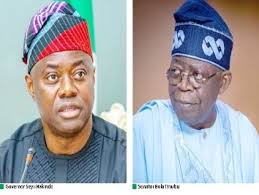
Twenty-three years ago, there was a Yoruba president in Abuja—Olusegun Obasanjo. The last governor standing in defiance of that presidency was another Yoruba man, Bola Ahmed Tinubu. Today, Tinubu occupies that same seat, and, in a neat irony of history, he faces his own version of Tinubu, his own upstander.
So, I wonder what thoughts crossed Tinubu’s mind as news of the Ibadan meeting and its declaration – and of the man who convened it – reached him. Could he see in it the quiet symmetry of history? Karma, perhaps; nature paying back, in familiar coins, what was once spent generously by him between 2003 and 2007.
The choice of Ibadan for the meeting was strategic. It was akin to Julius Caesar carrying the war to Pompey—taking the contest to a ground heavy with meaning. It is significant that Makinde, in his speech, described the city as Nigeria’s political capital. Stretch the meaning of “political” beyond office and title, take it into influence, memory, and the theatre of power, and test that claim against the country’s history, and you may find the governor was not merely being rhetorical. He was, arguably, right. Ibadan has weight when power is contested.
Then I found it curious that speaker after speaker at the event, suggested that the host had taken a risk by convening the meeting. Each time the remark dropped, I paused. What risk?
In Yorubaland, elders do not die with their skulls missing. And in all the history I have read and heard, Ibadan does not birth or raise a man who steps into the waters of battle only to shiver.
Those who gathered in that city from across Nigeria on Saturday said they were there for democracy. But what, exactly, is their definition of democracy? This one that replaces the bad with the worse, and the worse with the worst?
We read in the Bible (Genesis 6:6) that God created man, looked at what He had made, and “was grieved in His heart.” One hears echoes of that grief in today’s democratic experience. Calm, thoughtful people now ask, almost in resignation: ibo l’a já sí yìí? (where exactly have we found ourselves now)?
About two decades ago, American political theorist, Michael Hardt, observed that the word “democracy” had been so corrupted and abused that many thinkers preferred to avoid it altogether.
Hardt’s disappointment ran deep. Writing in 2007, he said democracy had become “difficult to pronounce… It tastes like ashes,” its once-beautiful promise burnt out by cynicism and reaction. What now marches under its banner, he argued, often resembles its opposite: war, authoritarianism, and deepening inequality. In many places, he warned, when you hear “democracy,” it may be wise to step aside.
Reading Hardt, one feels he was writing about Nigeria of today where democracy feeds the greedy and leaves behind the needy.
I listened attentively to the Oyo governor’s speech. He insisted the meeting was “not a gang-up against one man,” nor a sneaky platform for the ambitions of angling presidential hopefuls. Rather, he framed it as an expression of the collective will of Nigerians to reclaim a proper democracy.
But before that reassurance, there came from him a warning: “A significant majority of state governments are aligned under one party. There are open efforts to consolidate legislative control under one party.” In those words, he gave voice to a fear many whisper, that democracy here may have acquired a meaning that subverts its own popular definition.
John Adams, one of America’s founding fathers, left behind reflections on democracy that were not always flattering. He warned romantics of the system: “Remember, democracy never lasts long. It soon wastes, exhausts, and murders itself. There never was a democracy yet that did not commit suicide.” In simpler terms, democracy begins to commit self-murder the moment it kills competition. I heard that warning in virtually all speeches delivered on Saturday.
Makinde’s speech was as bold as his decision to host that gathering of Abuja’s ‘enemies’. In Yorubaland, when a load refuses the rafters and rejects the floor, there is always a third place to set it. The Ibadan meeting suggests that the ancient city on Saturday served as that third place—a refuge from the sword and sharp edges of the ‘omnipotence’ of power.
So, if there were “terrified” voices at the Ibadan gathering, wondering where the relatively young occupant of the Oyo State Government House draws his courage, they need only look to history—to what the past of his people has long deposited in their character, the tonic that gave Ibadan its peculiar gravitas.
Professor Bolanle Awe, writing in December 1965, offers more clue: Ibadan began “as a melting pot of warriors” from across Yorubaland. From that origin, the city drew men of daring, freelance soldiers and adventurers, bound not by kinship, as in other towns, but by a shared appetite for risk, for war, and for a life less restrained by threats from any authority.
Professor Falola, Africa’s preeminent historian, author of over 200 books, Bobapitan of Ibadanland, knows the land, waters and dwellers of his city inside out. Very few could give the clinical character analysis he has here: “Ibadan heroes fit perfectly into a dramatic plot. Generally, the hero faces a challenge and requires adventures that lead him to difficult places and peoples. He must persevere and endure great hardship. The hero never dies a useless death. Those of the nineteenth century had sufficient charms and courage to endure, and, when both failed, they had the opportunity to call upon their ancestors, spirits and gods to intervene. The Ibadan warriors travelled in the world of spirits, animals, people, and odious characters. Thus, Ogunmola, a dominant figure, was smart, bold and wise, and used all these qualities to win his wars.”
So, was I surprised when Seyi Makinde momentarily looked away from his prepared speech, praised his Ibadan, invoked its history of resistance (weti e), smiled, and took a swipe at “those acting as if there is no tomorrow”? No.
That is Ibadan—its drama, its theatre, and the character of its leaders. The city carries a daring heritage, forged in war. Where such heritage is absent, wounds appear on the back; in Ibadan, men meet their battles face to face.
A melting pot carries the DNA of all its parts. In Ibadan, that DNA is daring: the resolve to fight, to win, and to stand at the top.
Here again, I turn to Falola’s ‘Ibadan’ (page 856): “The ambition of many Yoruba elite, especially the politician, is to become a hero of the nation. Many have tried in vain” because they refused to learn from history. Ibadan’s story teaches that such stature is earned, forged in war, in political struggle and in culture.
Many still wonder where Bola Tinubu found the courage to confront Olusegun Obasanjo at the height of his imperial presidency. The answer may lie in his formative years in Ibadan of the 1970s, where he was steeped in the city’s lores, mores, and methods. Seyi Makinde, the man now standing up to him on the other side of that political tradition, was born and bred in Ibadan. The stage, therefore, is set for a drama like no other.
And let no one cry “betrayal” or invoke Yoruba Ronú as this drama unfolds. If it was not betrayal when a previous Yoruba president was fiercely challenged by a fellow Yoruba son, it cannot suddenly become one now.
In all this, where are we, and where are we going? We know how precarious the Nigerian state and its politics remain. Colonial civil servant and English academic, Martin Dent (11 July 1925 – 2 May 2014), in his review of the major events that fractured Nigeria’s First Republic (beginning from Ibadan), described politics as “a confused business much dependent upon money and involving the use of thugs.” He wrote in July 1970.
Nearly six decades later, those words still ring true. But it would appear that money (especially more money) has trumped thuggery as the more enduring currency of power. With party primaries upon us and the real contest already casting a long, menacing shadow, politicians will deploy more than those two ingredients to cook the 2027 broth.
In ‘Ogboju Ode Ninu Igbo Irunmale’, Fagunwa’s hunters walk into the forest of fear fully aware that not every hunter who enters returns with his story intact. The politics of the next polls is a frightening theatre of the heartless, yet men and women are already casting their lots and buying tickets “in defence of democracy.” I respect their courage and salute their resolve. I wish I could stand among them, but I am an orphan. Only the Ogboju Ode choose the forest of a thousand demons as their hunting ground.