- Says I can’t afford to fail Nigerians
BY SEGUN ADEBAYO – The newly appointed Minister of Defence, General Christopher Musa (rtd) says Nigeria will not win the war against terrorists and bandits if governments at all levels continue with the absurd idea of negotiating and paying ramson to these criminal groups.
Also, he said Nigeria’s fight against insecurity would remain ineffective unless there is an established and unified national database that capture every citizen and link all security, banking and identity systems together.
Importantly too, the Ministerial nominee said given the enormity of this national assignment, he cannot afford to fail Nigerians, his family and himself.
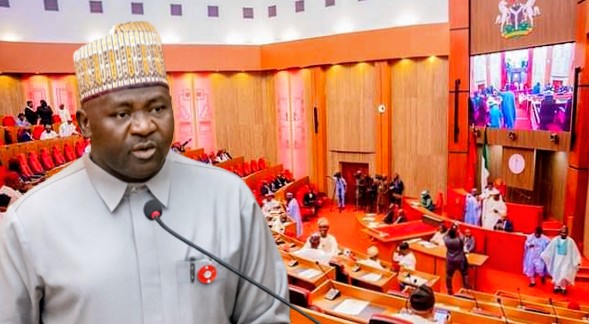
Speaking during his screening by the Senate, General Musa insisted that there should be no negotiations or payment of ransom to terrorists or bandits going forward, warning that such actions have continued to embolden the criminal elements in carrying out their deadly activities.
General Musa, who was appointed by President Bola Tinubu, on Tuesday, December 2, 2025, told the Lawmakers, “There should be no negotiation with any criminal. When people pay ransoms, it buys terrorists time to regroup, re-arm and plan new attacks. Communities that negotiated still got attacked later.”
He said government at all levels must demonstrate leadership by enforcing a total ban on ransom payments and negotiations with terrorists and bandits, adding that ransom money could be digitally monitored.
Maintaining that Nigeria’s banking system has the capability to trace financial flows connected to crime if fully activated, General Musa however said, “kinetic efforts alone cannot win the war” as military operations represented only 25–30 percent of the counter-insurgency efforts.
The former CDS noted that factors which continue to feed criminal activities nationwide include poverty, illiteracy, poor governance and weak local government structures.
This is as he acknowledged that the security agencies alone can hardly shoulder the entire national burden, with a challenge that State and Local Government administrators should take responsibility for community-level intelligence and early intervention.
He also took a swipe at Nigeria’s slow justice system, especially the prolonged trials for terrorism and kidnapping, explaining that such delays weakened morale within the armed forces.
In canvassing urgent legal reforms, including special terrorism courts, stronger penalties and accelerated hearings, General Musa said: “In some countries, terrorism cases are handled decisively. Here, cases drag for years. It discourages security forces who risk their lives to make arrests.’
With the promise to give his best in restoring peace across Nigeria, the Army General said: “On expectations, I can tell you, I am also feeling the heat; because when I see the reactions after my name was mentioned, I knew that I could not afford to fail myself, fail my nation, fail my family. Whatever that we need to do, we will put in the very best and I know with God on our side, we are going to succeed.
“I really appreciate the responses. I went to social media and I was shocked when I saw the responses. It shows that people are really committed in showing that Nigeria is peaceful.
“So when people go around saying we Nigerians don’t love us, I say no, they don’t really know who Nigerians are. And it also brings me to the issue that we have on whether genocide or not genocide, we are all victims. Everybody is being killed, everybody is dying.
“So that’s why it’s important that we must work together. And it is when we allow them to have gaps that they penetrate, they don’t care who they kill. These are a bunch of evil people that are on drugs.
“For whatever reason, we must stop the killings. Nigerians must not be killed or anyone in Nigeria must not be killed for whatever reason. So sir, our own target is to face them squarely and ensure that we stop the killings.”
On the issue of data base, General Musa described the country’s fragmented data architecture as one of the biggest obstacles to tracking criminals, dismantling networks, and preventing repeat offenders from operating freely across states.
He said having the nation’s multiple data sitting in silos, operated separately by immigration, quarantine services and other agencies, have created dangerous gaps exploited by terrorists, kidnappers, bandits, cyber-criminals and illegal mining syndicates.
For him, integrating ICT into the security architecture would not only revolutionise investigations, but also allow agencies to trace ransom payments, monitor suspicious transactions and profile criminal networks in real time.
He thanked the President for appointing him and Nigerians for having confidence in him to dekiver on the assignment of protecting the citizens and securing the country.