“The task before all of us is to build a democratic culture capable of delivering peace, prosperity, justice, opportunity and sustainable development to present and future generations”.
BY OKECHI OSUALA

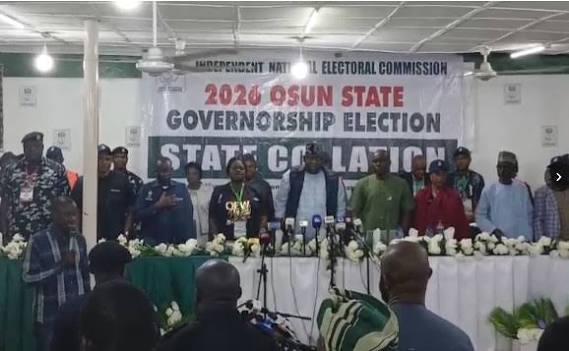
The conclusion of the 2026 Osun State Governorship Election provides Nigeria with another important opportunity to reflect on the state of our democracy, the behaviour of political actors, the power of the electorate and the responsibilities of institutions entrusted with protecting the democratic process.
The Independent National Electoral Commission (INEC) declared the incumbent Governor, Senator Ademola Adeleke of the Accord Party, the winner of the election after he secured 511,067 votes, defeating the All Progressives Congress (APC) candidate, Bola Oyebamiji, who polled 444,815 votes. Adeleke also won 19 of Osun State’s 30 Local Government Areas, while Oyebamiji won 11.
Beyond the figures, however, lies a much bigger story.
What does Osun teach Nigeria?
At the Centre for Public Affairs Research & Development (CENPARD), we believe elections should not merely be studied as contests between political parties and candidates. They should be examined as instruments for understanding governance, political behaviour, citizen participation, institutional performance and the development of democratic culture.
From this perspective, the Osun election offers several important lessons.
1. THE PEOPLE REMAIN THE ULTIMATE POLITICAL ASSET
The most fundamental lesson is that political power ultimately depends on the people.
Candidates may have political structures, financial resources, influential supporters, powerful godfathers, media campaigns and sophisticated mobilisation strategies. At the end of the process, however, citizens still possess the decisive instrument – the ballot.
The Osun result demonstrates once again that an incumbent’s political advantage does not automatically guarantee victory, just as an opposition party’s strength does not automatically translate into electoral success.
The electorate remains the final political marketplace.
Political leaders who understand this will spend more time listening to citizens and less time assuming that citizens owe them their votes.
2. PERFORMANCE MATTERS
An incumbent seeking re-election is effectively asking the electorate to conduct a referendum on his administration.
The central question becomes: “What have you done with the opportunity we gave you?”
During the campaign, Governor Adeleke repeatedly highlighted infrastructure, healthcare, education, workers’ welfare, agriculture, economic development and other areas of government performance.
Whether voters agreed with every claim or not, the political lesson is clear:
Governance creates political consequences.
A government must therefore understand that projects, policies, employment opportunities, social interventions, infrastructure and economic activity are not merely administrative statistics. They shape how citizens perceive leadership.
3. OPPOSITION PARTIES MUST BUILD, NOT JUST CRITICISE
One of the recurring weaknesses of opposition politics in Nigeria is excessive dependence on criticism.
Criticism is necessary in a democracy. However, criticism without a credible alternative vision eventually loses persuasive power.
The Osun contest demonstrates that an opposition party must be able to answer a simple question:
“Why should the people trust us with power?”
That answer must go beyond saying that the incumbent has failed.
It should present a convincing alternative programme for economic development, employment, infrastructure, education, healthcare, security, agriculture and social welfare.
The strongest opposition is not necessarily the loudest.
It is the opposition that convinces citizens that tomorrow will be better under its leadership.
4. POLITICAL PARTIES MUST NOT TAKE THEIR VOTERS FOR GRANTED
The Osun election also demonstrates the importance of political organisation.
Political parties are not supposed to exist merely during election seasons.
A serious political party should maintain permanent structures for:
– policy development;
– membership development;
– grassroots engagement;
– voter education;
– leadership development;
– research;
– communication;
– conflict resolution; and
– public accountability.
A party that disappears after an election and resurfaces shortly before another election is not building a democratic institution. It is merely constructing an electoral machine. Nigeria needs political institutions, not seasonal political machines.
5. INTERNAL PARTY DEMOCRACY MATTERS
The quality of a general election is partly determined by what happens before election day.
If political parties conduct transparent, credible and inclusive internal processes, they are more likely to produce candidates who enjoy legitimacy among their members.
Where internal party politics becomes dominated by imposition, factionalism, financial influence and personal interests, the consequences frequently spill into the general election.
The Osun experience therefore reinforces a broader national lesson: Democracy must begin within political parties before it can effectively operate in government.
6. ELECTORAL TECHNOLOGY CAN STRENGTHEN PUBLIC CONFIDENCE
The 2026 Osun election also highlighted the growing role of technology in electoral administration.
INEC deployed 4,427 BVAS devices, including backup units, for the election, while the state had 3,763 polling units. Results were also uploaded progressively to the IReV platform.
Technology alone, however, cannot create electoral integrity.
Technology must be supported by: credible personnel + transparent procedures + reliable logistics + strong institutions + responsible political actors.
The objective should not simply be to digitise elections. The objective should be to make elections more credible, transparent, verifiable and trusted by citizens.
7. THE ELECTORAL COMMISSION MUST REMAIN ABOVE POLITICAL PRESSURE
INEC carries one of the greatest responsibilities in Nigeria’s democratic system.
The commission must continue to strengthen public confidence by demonstrating independence, transparency, professionalism and consistency.
Before the election, INEC repeatedly assured stakeholders that the Osun poll would be free, fair, credible and inclusive.
Such assurances are important. But even more important is the institutional evidence that citizens can independently examine. Trust in elections is built through demonstrable integrity, not merely official declarations.
8. VOTER EDUCATION MUST BECOME A PERMANENT NATIONAL PROJECT
Democracy cannot function effectively when citizens are politically uninformed.
Voters should understand:
– how elections work;
– how to protect their voting rights;
– how to verify electoral information;
– how to identify misinformation;
– how to report electoral violations;
– why their votes matter;
– how to evaluate candidates;
– and what responsibilities they have after elections.
The voter should not be treated merely as someone to mobilise during campaign season.
The voter is a stakeholder in governance.
9. MONEY POLITICS REMAINS A SERIOUS THREAT
One of the disturbing issues raised around the Osun election was the allegation of monetary inducement and attempts to compromise voters’ cards. Governor Adeleke publicly urged citizens to reject monetary inducements and protect their Permanent Voter Cards.
Regardless of partisan claims and counterclaims, the broader issue deserves national attention.
When citizens sell their votes, they may receive immediate financial benefits, but society ultimately pays a much higher price through poor governance, corruption and weakened accountability.
A vote is not a commodity. It is a constitutional instrument through which citizens participate in determining who controls public resources.
10. POLITICAL VIOLENCE MUST NEVER BECOME NORMAL
Nigeria has witnessed too many elections in which political competition has degenerated into intimidation, violence and destruction.
That culture must end. Political opponents are not enemies. They are competitors within the same democratic system. A candidate who loses today may win tomorrow. A party that loses an election may form the next government. Political power is temporary; the state and its people remain.
Therefore, no election is worth the blood of a Nigerian.
11. SOCIAL MEDIA IS NOW A POLITICAL BATTLEGROUND
The Osun election again demonstrates the enormous influence of social media on political communication. Candidates, parties, supporters, celebrities, activists and citizens can now communicate directly with millions of people.
This is an opportunity – but also a danger. Misinformation, propaganda, manipulated videos, fake results and inflammatory narratives can spread faster than verified information.
The new political responsibility is therefore: Think before you share. Verify before you believe. Investigate before you accuse. Digital literacy is now democratic literacy.
12. CELEBRITY INFLUENCE IS NOT THE SAME AS ELECTORAL POWER
The Osun election also offers an interesting lesson about celebrity participation in politics.
Celebrities can influence public conversation, shape narratives and mobilise younger audiences. But electoral outcomes ultimately depend on citizens who actually participate in the voting process.
Fame can generate attention. Only voters can generate electoral victory. Political strategists should therefore distinguish between visibility, popularity, influence and actual electoral capacity.
They are not the same thing.
13. LOCAL GOVERNMENT REMAINS CRITICAL
The final result also demonstrates why political strategists must understand the grassroots.
Osun has 30 Local Government Areas, and the distribution of votes across these areas mattered significantly to the final outcome.
A candidate can enjoy strong support in certain communities and still lose an election if that support is not sufficiently distributed. Therefore, effective political strategy requires: Statewide vision + local intelligence + grassroots organisation. The ward remains important. The polling unit remains important. The individual voter remains important.
14. LOSING AN ELECTION DOES NOT MEAN LOSING THE FUTURE
Every election produces winners and losers. However, democracy should never permanently label anyone a winner or loser. Today’s loser can become tomorrow’s winner – provided that the individual or party learns from the experience. The appropriate response to electoral defeat should therefore not be bitterness, violence or destruction.
It should be: Review. Reflect. Reform. Reorganise. Return.
Political parties that learn from defeat become stronger.
Those that refuse to learn eventually disappear.
15. WINNING AN ELECTION IS NOT THE SAME AS GOVERNING SUCCESSFULLY
This may be the most important lesson of all. An election victory is only the beginning. The real test begins after the celebration. The people will eventually ask:
– Are there jobs?
– Is the economy growing?
– Are schools improving?
– Are hospitals functioning?
– Is infrastructure expanding?
– Are citizens safer?
– Are businesses thriving?
– Are public institutions stronger?
– Are government resources being responsibly managed?
– Is poverty declining?
– Is the quality of life improving?
Winning the mandate is political success. Delivering the mandate is leadership success.
16. OSUN 2026 IS ALSO A MESSAGE TO 2027
The Osun election has significance beyond Osun State.
It is one of the most important political signals before Nigeria’s 2027 general elections.
Political parties, presidential aspirants, governors, legislators and political strategists should study the election carefully – not merely for its winners and losers, but for the behaviour of voters.
The lesson is that Nigerian voters are increasingly important variables in political calculations.
The era when politicians could simply assume that political structures would automatically deliver votes is becoming increasingly difficult to sustain.
The voter is becoming more important than the political slogan.
17. DEMOCRACY MUST PRODUCE DEVELOPMENT
Ultimately, elections are not an end in themselves. Democracy should produce better governance. Better governance should produce stronger institutions. Stronger institutions should produce economic opportunity. Economic opportunity should improve living standards. Moreso, improved living standards should reduce poverty and inequality. Therefore, the true measure of democracy is not simply: “Who won the election?”
The deeper question is: “What will the people gain from the government that has won?” That is where our national conversation must move.
CENPARD’S POSITION
As the Centre for Public Affairs Research & Development (CENPARD), we congratulate the people of Osun State for participating in another important democratic exercise.
We also acknowledge the responsibility now placed on the declared winner and all elected political actors to govern inclusively and responsibly.
We urge all political parties and candidates to pursue legitimate constitutional and legal channels where they have concerns about the electoral process.
We equally call on citizens, political parties, civil society organisations, the media and government institutions to protect the peace and democratic stability of Osun State.
Our democracy must mature beyond the politics of “my candidate versus your candidate.”
Nigeria needs a new political culture built around:
Citizenship over godfatherism.
Ideas over propaganda.
Performance over promises.
Institutions over personalities.
Peace over violence.
Accountability over impunity.
Development over political rivalry.
THE FINAL LESSON
The greatest lesson from Osun is not that one candidate won and another lost. The greatest lesson is that political power remains a trust temporarily granted by citizens.
Every mandate has an expiry date. Every government will eventually return to the people for judgment. Every politician will eventually become a former politician. Notably, the consequences of governance remain with the people.
Therefore, those who win should govern with humility.
Those who lose should learn with courage.
Those who vote should remain vigilant.
Those who administer elections should remain impartial.
Ipso facto, those who participate in politics should remember that Nigeria is bigger than any political party, candidate or election.
The task before all of us is to build a democratic culture capable of delivering peace, prosperity, justice, opportunity and sustainable development to present and future generations.
That is the real meaning of public service.
That is the real test of democracy.
That is the lesson Nigeria must take from Osun.
…Dr. Okechi Osuala is the Executive Director, Centre for Public Affairs Research & Development (CENPARD)