- Lists reforms benefits as wage increases, infrastructure, social transfers, others
- Admits the fight against poverty still rages on!
BY COBHAM NSA – The Federal Government says its bold economic shakeup in eliminating fuel subsidy and floating the Naira pumped a staggering ₦15.8 trillion in savings back into the Federation coffers covering a 30-month period between June 2023 and December 2025.
According to the Minister of Finance and Coordinating Minister of the Economy, Taiwo Oyedele, this massive financial savings from the reforms had provided additional resources for the government to fund critical programmes and interventions across the country.
This is as the Minister also admitted that poverty reduction and improved household welfare remain “unfinished business” for the Federal Government despite the significant gains recorded with ongoing economic reforms.
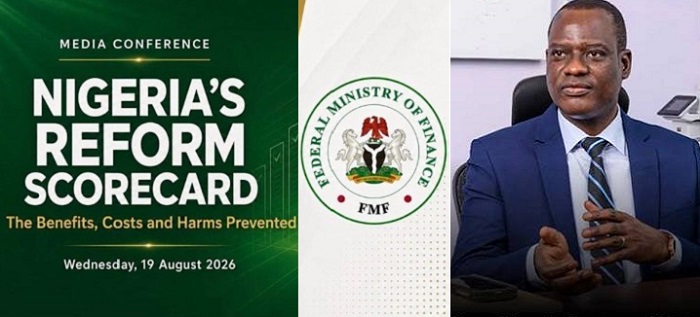
Oyedele, who unveiled the staggering figure at a media briefing in Abuja tagged: “NIGERIA’S REFORM SCORECARD: THE BENEFITS, COSTS AND HARMS PREVENTED”, pointedly said, “Between June 2023 and December 2025, subsidy savings mobilised a sum of N15.8tn in resources for the Federation.”.
He said with the impressive saving profile, the government has deployed resources generated through the reforms in several areas, noting that the measures aimed at cushioning their impact while generally improving the welfare of Nigerians.
Noting that the reforms have largely contributed to wage increases and timely payment of salaries and pensions, as well as the settlement of outstanding pension arrears and gratuities owed to retirees, the MInister said the benefits of ongoing reforms are visible in areas such as the capital market growth, infrastructure development and improved access to affordable credit among others
Oyedele further listed other interventions by the government to include expanded access to student loans through the Nigerian Education Loan Fund (NELFUND), supporting affordable consumer and small and medium enterprise (SME) credit, subsidised mortgage and housing schemes, as well as social transfers targeted at about 15 million vulnerable households nationwide.
With improved fuel availability and efforts to address energy shortages despite global economic shocks cited among positive outcomes of the reforms, he said these have not only helped in restoring investor confidence, but ultimately resulted in increased domestic and international investments.
Also turning attention to issues around taxation, the Minister noted that while tax exemptions protect low-income earners and small businesses, the government is still pushing for a business-friendly tax environment, stressing that the reforms must be judged not just by their costs, but by their economic benefits and the major crises they help the nation avoid.
Further assuring that the government remained committed to ensuring resources generated through the reforms were channelled into programmes and investments capable of improving living standards and strengthening the Nigerian economy, Oyedele said average Nigerians are reaping the benefits in terms of wage increases and timely payment of salaries and pensions; Settlement of pension arrears and gratuities owed to retirees; Wealth creation for millions of Nigerians through capital market gains; and Transformative infrastructures development nationwide.
Additionally, he said Nigeria is reaping major economic gains, highlighted by the NELFUND student loan scheme, affordable SME credit, subsidized housing, and social transfers supporting 15 million vulnerable households, agricultural food security boosts, stable fuel and energy access, surging investor confidence, and low-income tax exemptions.
While acknowledging that the fight against poverty is still raging on with the government fully determined to put smiles on the faces of Nigerians, the Minister said there is no argument on the fact that improvements in key macroeconomic indicators must ultimately translate into better living conditions for Nigerians.
However, he noted that food inflation has eased from 24.82 per cent to 17.52 per cent as of June 2026, while headline inflation stood at 15.91 per cent, while also pointing to growth in Nigeria’s foreign reserves, stock market capitalisation and real GDP as evidence that the economy is moving in the right direction.
Cautioning against interpreting the warming numbers as proof that the economic recovery is complete, Oyedele said: “Poverty and household welfare recovery is still classified in our own scorecard as unfinished business, not a victory lap”, stressing that the government’s next priority would be to translate macroeconomic stability into improvements that Nigerians can actually feel in their daily lives.
As part of the reform programme’s next steps, the Minister said expanded cash transfers to vulnerable Nigerians, deeper agricultural interventions to reduce food prices, and greater collaboration with state and local governments on social welfare packages would enjoy priority attention going forward.