“We are not competing for a seat at the same table. Rather, we are co-building a bigger, stronger table with our male allies and champions”
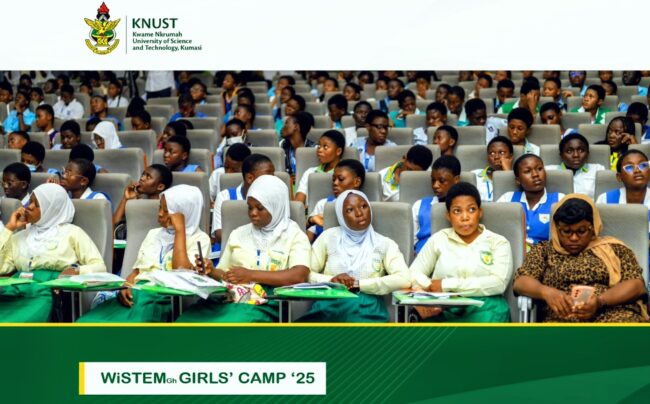
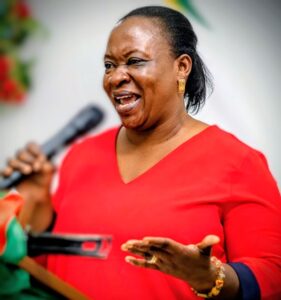
The President of Women in Science, Technology, Engineering and Mathematics (WiSTEMGh), Professor (Mrs) Ibok Nsa Oduro, has challenged young women to reject self-imposed limits in pursuit of exciting careers in Science, Technology, Engineering, and Mathematics (STEM).
According to her, it is important that young women consciously embrace innovation because “No limit is only what one creates in the mind.”
Addressing participants at the 2025 WiSTEMGh Girls’ Camp at Kwame Nkrumah University of Science and Technology (KNUST) in Kumasi, Ghana, Professor Oduro said, “You have every opportunity in STEM to move on. The only limits in our lives are those we impose on ourselves.”
With this year’s Camp’s theme, “STEM Without Limit: Empowering and Inspiring Girls Who Change the Game”, on her mind, the Professor of Postharvest Technology at KNUST’s Department of Food Science and Technology, said, “Changing the narrative requires a game-changing mindset. STEM is not their field; it is our field. It is a world we build, and we are the architects.”
Professor Oduro also stressing the need for collaboration to address global challenges such as climate change, health, and food security.
“We are not competing for a seat at the same table. Rather, we are co-building a bigger, stronger table with our male allies and champions”, she said
On the challenge of sustaining the program, Prof Oduro, who is also the Founder of WiSTEMGh, appealed to government, industry, and private partners to step in with financial support in order to expand the project.
“If every community or stakeholder decides that they are going to pick two schools from their regions and sponsor them, we will be open to do that,” she posited.
Also speaking at the WiSTEMGh Girls’ Camp, the Quality and Food Safety Manager at Olam Food Ingredients (OFI), Mrs Mary Arthur, emphasized the importance of focus, mentorship, and resilience in STEM careers.
She said, “There is nothing like a limit when it comes to STEM education. You can go as far as you can if you have focus and the right mentors. Ask questions, challenge the status quo, and truly be a game changer”.
On her part, the Head of Digital Transformation at Stanbic Bank, Mrs Estelle Asare, shared her journey as a proud KNUST alumna, highlighting the bank’s commitment to STEM education.
Hear her, “Brilliance knows no boundaries. It is not defined by your gender, your background, or where you were born. Supporting initiatives like this is an investment in the future of our communities and our continent.”
She stated that Stanbic Bank has already donated over 350 laptops to support STEM education at KNUST and called on the girls to embrace innovation with confidence.

For Mrs Dorothy Oye Debrah, Girl-Child Education Coordinator at the Oforikrom Municipal Assembly, Kumasi, it is important that participants are encouraged to be intentional about the opportunity.
She told the young women, “Be very inspired, be very innovative, and be very intentional. Put in your head, heart, and hands, and leave here ready to change the game.”
Offering further insights on the program, Head of the Gender Inclusive and Vulnerability (GIV) office at KNUST and General Secretary of WiSTEMGh, Professor Mercy Badu, said exposing young women to practical applications is key to fueling their interest.
The annual initiative brings together young female students from second-cycle institutions across Ghana to ignite their passion for STEM while equipping them with the mindset and skills to become trailblazers in their chosen fields.
Now in its sixth year, the week-long camp has 320 students from 30 schools across five regions at the KNUST. It brings together girls, mostly pursuing General Science, with the aim of demystifying science while building their confidence and interest in STEM education.
With 60 percent of participating schools drawn from rural communities, organizers say the camp is deliberately structured to bridge the gap between elite urban schools and those with fewer resources
The camp takes students out of the classroom and into real-world experiences, including industrial tours, mentorship sessions, and hands-on projects.