…when political devotion meets the economics of survival
BY LANRE OGUNDIPE
Nigeria never disappoints.
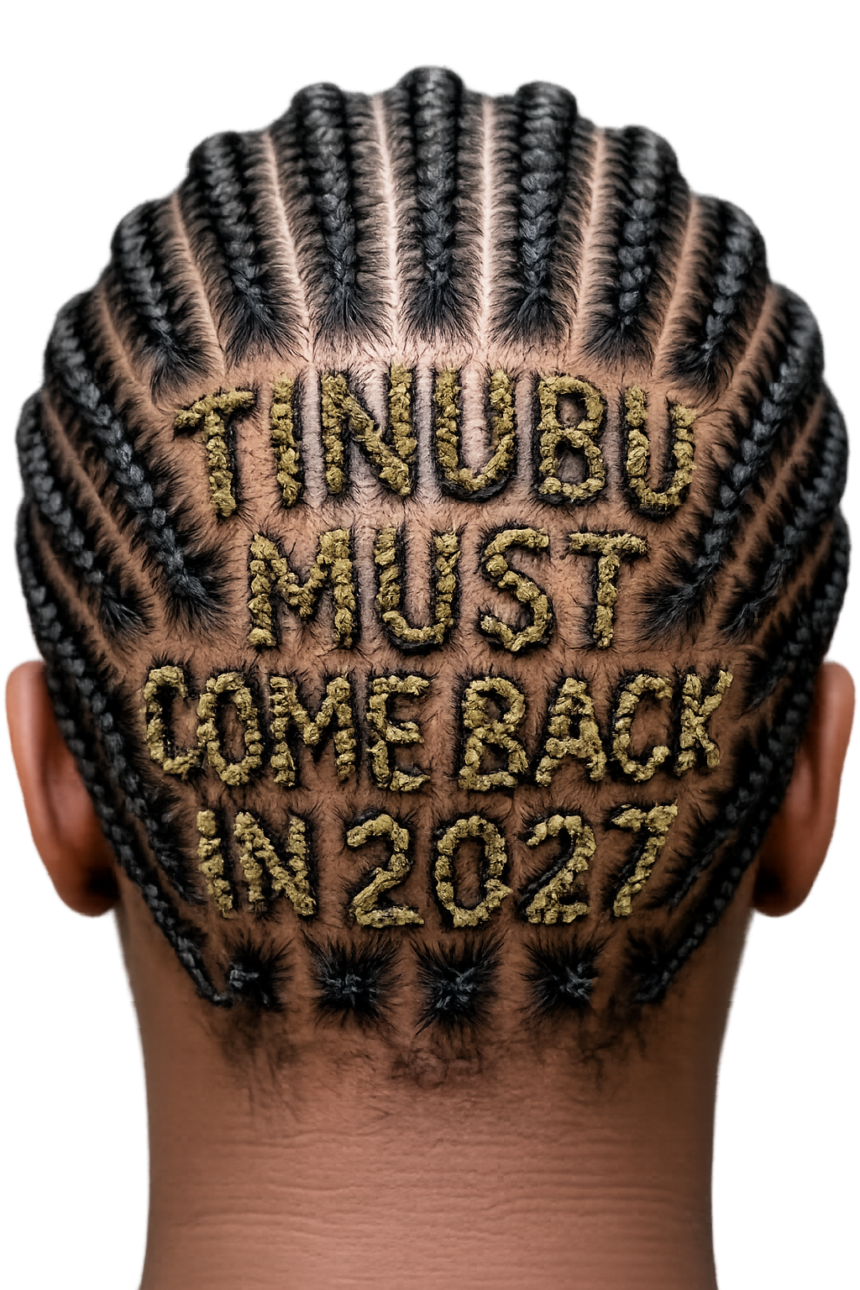
Just when citizens thought they had seen every conceivable form of political expression, a new masterpiece emerged from an unlikely canvas: the human scalp.
There it was, intricately woven into carefully crafted braids – a political declaration boldly announcing support for President Bola Ahmed Tinubu’s return in 2027.
The image immediately went viral. Supporters hailed it as creativity. Opponents dismissed it as sycophancy.
The politically neutral simply wondered how many hours were required to transform a human head into what looked remarkably like a mobile campaign billboard.
Yet beyond the humour lies a deeper national conversation.
For while the hairstyle speaks of political devotion, millions of Nigerians continue to speak of something else entirely: survival.
The administration calls them reforms.
The streets call them T-Pains.
Every government has its slogans. Every presidency develops its vocabulary.
This administration promised renewed hope.
Many citizens insist they first encountered renewed hardship.
Fuel subsidy removal was presented as economic necessity.
For millions of commuters, it became a daily arithmetic exercise in survival.
Currency reforms were designed to stabilize the economy.
For countless small businesses, they introduced fresh uncertainties.
Inflation became a permanent guest at the dinner table.
Food prices acquired wings.
Transportation costs developed their own inflation rate.
Electricity tariffs rose with remarkable enthusiasm.
Only salaries appeared committed to fiscal discipline.
Against this backdrop arrived the famous hairstyle.
And suddenly the image became bigger than hair.
It became a metaphor.
The carefully woven message represented one Nigeria.
The exposed scalp beneath represented another.
One speaks of confidence in the future.
The other worries about the cost of the present.
One celebrates courage in reform.
The other asks how much courage is required to buy a bag of rice.
Perhaps this is why the photograph attracted so much attention.
It unintentionally captured the defining tension of contemporary Nigeria.
A government seeking patience.
A population running short of it.
A leadership asking citizens to trust the destination.
A citizenry struggling with the cost of the journey.
The irony is almost poetic.
The slogan was braided with impressive precision.
Unfortunately, inflation has shown far less respect for neat arrangements.
The hairstyle was carefully maintained.
The purchasing power of ordinary Nigerians has not enjoyed the same luxury.
The braids followed orderly lines.
The prices in the marketplace appear to follow none.
To be fair, the administration’s defenders insist history will vindicate today’s sacrifices.
They argue that difficult reforms are rarely popular.
They remind critics that previous governments postponed painful decisions.
They urge Nigerians to judge outcomes rather than temporary discomfort.
Perhaps they are right.
History has occasionally rewarded leaders who endured public criticism while implementing difficult reforms.
Yet history also records a stubborn fact: citizens do not experience the future in advance.
They experience today’s transport fare.
Today’s electricity bill.
Today’s school fees.
Today’s market prices.
A mother standing before a food vendor cannot pay with future prosperity.
A trader facing declining sales cannot survive on projected growth figures.
An unemployed graduate cannot convert economic theories into dinner.
This is where the hairstyle becomes unintentionally profound.
It symbolizes faith.
Faith in leadership.
Faith in policy.
Faith in promises.
Faith that today’s pain will eventually produce tomorrow’s gain.
Faith, however, has always been easiest for those least burdened by hardship.
For the struggling majority, faith competes daily with reality.
And reality, unlike campaign slogans, demands payment upfront.
That is why the image generated laughter.
Not because Nigerians dislike creativity.
Not because Nigerians dislike politics.
But because many citizens saw in those braids a striking contrast between political enthusiasm and economic anxiety.
The message on the scalp said 2027.
The conversation beneath it was still about 2026.
The slogan looked ahead.
The people remained trapped in the present.
Perhaps that is the enduring lesson.
Political branding can be woven into hair.
Campaign messages can be braided into fashion.
Loyalty can be displayed on the scalp.
But public approval is woven elsewhere.
It is woven in the marketplace.
In the fuel station.
In the electricity bill.
In the kitchen.
In the wallet.
And those are the braids that ultimately determine elections.
Long before campaign posters appear.
Long before slogans return.
And certainly long before another ambitious patriot offers his head to history.
For in politics, as in hairstyling, the final verdict is not given by the stylist.
It is given by those who must live with the result.