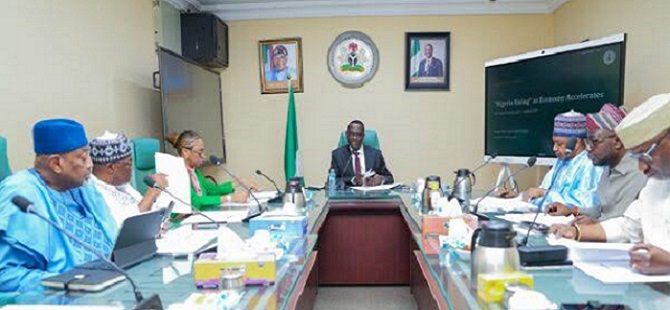
BY COBHAM NSA – As part of efforts to improve fiscal coordination and accelerate economic growth, the Federal Government has launched a high-level inter-agency committee to sync Nigeria’s core economic budgeting assumptions.
The plan, seeking to fix fiscal loopholes and supercharge national growth, was locked in during the Economic Management Team (EMT) meeting held in Abuja recently.
However, despite confirming the rollout, an official statement from the Federal Ministry of Finance (FMoF) remained conspicuously silent on who chaired the high-profile session.
According to the statement, the new committee will harmonise critical assumptions covering crude oil prices and production, exchange rates, inflation and non-oil revenue projections used by fiscal and monetary authorities.
This is as the EMT Secretariat further explained that the move followed a joint budget retreat and technical validation workshop which identified inconsistencies in economic assumptions across government agencies as one of the factors contributing to budget under-performance.
Crucially, the Committee will also target reporting discrepancies, smoothing out how vital economic data are shared with the government, the public, and external stakeholders.
This is as the statement said this push for transparency follows a recent economic uptick noted by the EMT that real Gross Domestic Product (GDP) growth surged to 4.43 per cent year-on-year in the second quarter of 2026.
Information released by the National Bureau of Statistics (NBS) described the Q2 performance as the strongest quarterly growth since the third quarter of 2024, even as the government also reported that external reserves had risen above $54 billion in early September, representing their highest level in almost 18 years, according to Central Bank of Nigeria (CBN) data.
Also noting that the Naira has strengthened to its firmest level in about two years, trading in the N1,300 range to the dollar in early September, the EMT lauded FTSE Russell’s decision to reclassify Nigeria from “Unclassified” to “Frontier Market” status, effective September 21, 2026.
The reclassification marks Nigeria’s return to the index after about three years and is expected to improve the visibility of Nigerian equities among international investors.
Additionally, the Team was also briefed that public debt remained below 40 per cent of GDP, while Nigeria’s sovereign credit outlook from Moody’s had improved from stable to positive.
Besides approving revised Terms of Reference for the EMT, the meeting expanded its responsibilities to include macroeconomic performance reviews, stronger fiscal and monetary policy coordination, monitoring of Renewed Hope Agenda priorities and periodic assessment of the Federal Government’s financing requirements.
Meanwhile, the EMT is aggressively tightening its grip on policy execution under a newly revamped mandate and moving from a less frequent schedule to an intensive monthly format, the high-powered advisory body is effectively doubling its oversight capacity.
As part of this sweeping structural overhaul, each assembly will mandate at least two deep-dive strategic sector reviews, a heavy operational shift designed to eliminate bureaucratic bottlenecks and rapidly accelerate economic reforms.
Also, to fix inconsistencies in official economic statistics reporting, the Ministry of Finance will take over as the central custodian of national data, though individual agencies, within their respective mandates, will continue to feed data from their different sectors.