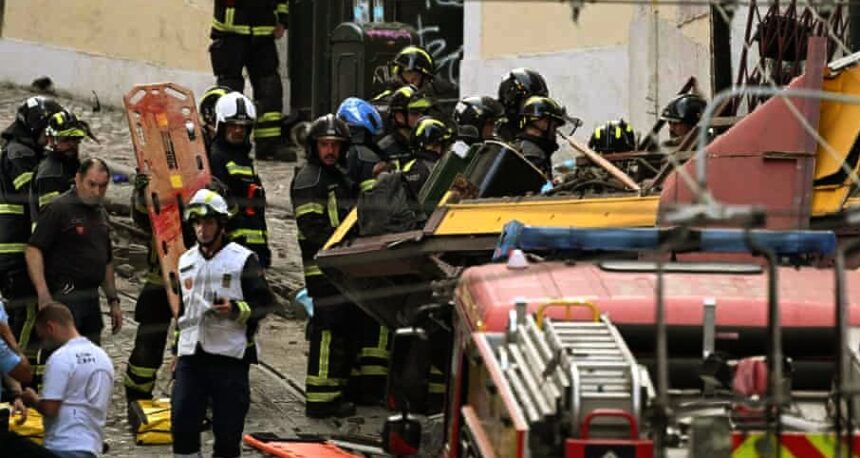
- 18 others injured as Gloria funicular railway car derails, crashes into a building
- Condolences pour in from Spain, Italy, UK, EU
Portugal has declared a day of national mourning following the death of at least 15 people after Lisbon’s well-known Gloria funicular railway car derailed and crashed on Wednesday.
An Emergency services spokesperson said some foreign nationals were among those who died in the incident but would not identify the victims or disclose their nationalities.
Reports also indicated that at least 18 people, including a child, were injured, five of them seriously.
Declaring that Thursday would be a day of national mourning following the tragic event, Portugal’s government said in a statement from the office of Prime Minister Luis Montenegro that the tragedy “has brought grief to … families and dismay to the country”.
Also, the Portugal’s President of the Republic, Marcelo Rebelo de Sousa, in a statement, lamented the accident and expressed hope that authorities would soon establish the cause of the crash.
He announced that the accident of a funicular railway caused several dead and seriously injured many in Lisbon
Police investigators were inspecting the site and the Prosecutor General’s office said it would open a formal investigation, as is customary in public transport accidents.
Lisbon’s Gloria funicular tram, which opened in 1885 and is classified as a national monument, connects the central Lisbon area near the Restauradores Square with the Bairro Alto (Upper Quarter), known for its vibrant nightlife.
It is one of three funicular lines operated by the Municipal Public Transport Company Carris and is used by tourists as well as residents.
Carris said in a statement that “all maintenance protocols have been carried out”, including monthly and weekly maintenance programmes and daily inspections.
Lisbon’s City Council suspended operations of other streetcars in the city and ordered immediate inspections, local media reported.
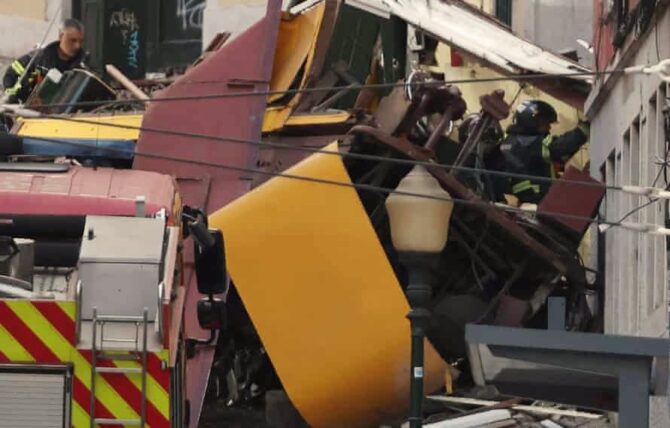
Already, public prosecutors have launched an investigation into the cause of the disaster, even as footages showed the wreckage of the yellow and white car, which is known as Elevador da Glória.
The car usually goes up and down a steep hill in central Lisbon in tandem with one going the opposite way, lying on its side in the narrow street it traverses.
However, in the accident, its sides and top were crumpled, and it appeared to have crashed into a building where the road bends. Parts of the vehicle, made mostly of metal, were crushed.
Witnesses told local media that the streetcar careened down the hill, apparently out of control and crashed into a building on the narrow street it traverses.
“It hit the building with brutal force and fell apart like a cardboard box …” Teresa d’Avó told Portuguese TV channel SIC while one witness said the Streetcar toppled on to a man on the pavement.
Though the cause of the accident was not immediately known, reports said it occurred at the start of the evening rush hour, at about 6pm. Emergency officials said all victims were pulled out of the wreckage in just over two hours.
SITRA, a trade union, wrote in a post on social media that one of its members had died in the incident.
“It’s a tragic day for our city … Lisbon is in mourning, it is a tragic, tragic incident,” Carlos Moedas, the mayor of the Portuguese capital, told reporters.
The Gloria line transports about 3 million people annually, according to the town hall reports.
Its two cars, each capable of carrying about 40 people, are attached to opposite ends of a haulage cable with traction provided by electric motors on the cars.
The car at the bottom of the line was apparently undamaged, but video from bystanders broadcast by CNN Portugal showed it jolting violently when the other one derailed and several passengers jumping out of its windows and people shouting.
European Union Chief Ursula von der Leyen posted on X that “it is with sadness that I learned of the derailment … My condolences to the families of the victims.”
Spanish Prime Minister Pedro Sánchez wrote on X that he was “appalled by the terrible accident”, while Italian Foreign Minister Antonio Tajani wrote that he had met the Portuguese foreign minister and expressed his “solidarity with the victims”.
Portugal, and Lisbon in particular, has experienced a tourism boom in the past decade, with visitors cramming into the popular downtown area in the summer months.
A spokesperson for the UK’s Foreign, Commonwealth and Development Office said it was in touch with the local authorities and stood by “to provide consular assistance if there are any affected British nationals”.
Britain is the largest source of tourism to Portugal, followed by Germany, Spain and the United States. The US State Department did not immediately respond to a request for comment. – The Guardian with additional reports from Reuters and Associated Press