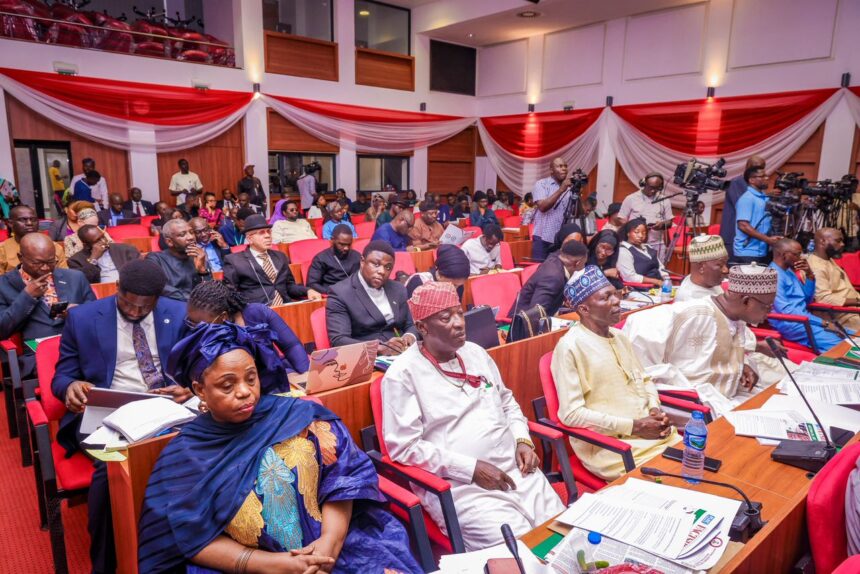
…As NASS moves to shift presidential, governorship polls to Nov 2026
Ahead of the 2027 general elections, concerned stakeholders have demanded the introduction of electronic voting and electronic transmission of election results.
The stakeholders that included civil society organisations (CSOs), Non-Governormental Organisations (NGOs), lawyers, academia, activist and members of the public, opined that electronic voting and transmission of results of elections would restore confidence in the system.
This was the National Assembly on Tuesday, October 13, 2025 at a one-day Joint Public Hearing organized of the Senate and House of Representatives Committees on Electoral Matters, proposed that the Presidential and Governorship elections be conducted in November 2026 as against the usual February or March date of an election year.
The National Assembly proposal is contained in the draft amendments to the 2022 Electoral Act, which seek to ensure that elections into the two executive offices are held not later than 185 days before the expiration of tenure of the incumbents fixed for May 29, 2027.
Based on the proposed Section 4(7) of the amendment, elections into the office of the President and Governor of a State shall be held not later than 185 days before the expiration of the term of office of the last holder of the office.
The provision also stated that the next presidential and governorship elections are expected to hold in November 2026, being about six months before the end of the current administration.
In the same vein, the proposed Section 4(5) stipulates that polls into the National Assembly and State Houses of Assembly be conducted not later than 185 days before the date on which each House stands dissolved.
As a means of addressing the constitutional limitations, the National Assembly Joint Committee said that sections 76, 116, 132, and 178 of the Constitution would be amended to transfer the authority for determining election timelines from the Constitution to the Electoral Act.

In his remarks at the public hearing, Hon. Adebayo Balogun, Chairman of the House Committee on Electoral Matters, said the proposed amendment would help ensure that all election litigations are concluded before winners are sworn in.
According to him; “To achieve this, we are proposing constitutional amendments that will reduce tribunal judgment time from 180 to 90 days, appellate court decisions to 60 days, and Supreme Court judgments to 35 days — all within the 185-day framework before swearing-in”.
The proposed reform also introduced early voting, which will allow specific categories of voters — including security personnel, INEC officials, accredited journalists, election observers, and ad-hoc staff — to cast their ballots up to 14 days before the general election.
Other key amendments being proposed include; mandatory electronic transmission of results, reduced dependence on the Permanent Voter Card (PVC) as a voting prerequisite, and stiffer penalties for electoral officers who breach election procedures.
Accordingly, under the proposed Section 60(5), presiding officers are required to transmit results both electronically and manually.
“Failure to comply, or distributing unstamped ballot papers and results sheets, would attract a one-year jail term, a ₦1 million fine, or both,” the provision stated.
Representatives of the Independent National Electoral Commission (INEC), that included Professor Abdullahi Zuru, described the proposed changes as steps that would enhance transparency, accountability, and confidence in Nigeria’s electoral system.