…Reopens contest for 2027 Senate Presidency
Following what is being considered pressure from different quarters, the Godswill Akpabio-led Senate on Thursday, May 7, 2026, rescinded the controversial amendment that was initially targeted to bar first-time senators from contesting principal offices particularly the presiding positions.
With the reversal of the amendment that was adopted on Wednesday which led to the Senate President, Godswill Akpabio threatening to send Senator Adams Oshiomhole out of the Senate, the 2027 race for Senate President and Deputy Senate President is now opened.
However, in a dramatic move on Thursday, the Senate Leader, Opeyemi Bamidele standing on a Point of Order, moved a motion for the reversal of the amendment of the Senate Rules, arguing that the amendment was inconsistent with the Constitution of the Federal Republic of Nigeria.
In the words of Bamidele’ “The Senate Standing Order was amended on 5th May, 2026. Upon further legislative and constitutional review, certain conditions introduced under Order 2 Subsection 2, Order 3 subsection 1, may give rise to constitutional inconsistency and bring tension with the provision of the Constitution.
“The Standing Order should remain consistent with constitutional provision,” he said.
After the Point of Order by Senate Leader, lawmakers unanimously adopted the amendment at the session presided over by that was adopted Thursday through a motion sponsored by Senate Leader Opeyemi Bamidele and presided over by the Deputy Senate President, Jubril Barau.
The earlier amendment that was adopted on Wednesday, required that any senator seeking to run for presiding or principal offices must have served in the Senate for two consecutive terms, totalling eight years.
The amendment effectively disqualified all newly elected senators and those returning after a break, thus restricted eligibility to a small pool of ranking lawmakers.
The amendment drew criticisms as it was perceived as a deliberate attempt to shut out high-profile political figures expected to join the Senate in 2027, including some outgoing governors and former ministers.
Critics of the amendment specifically said it narrowed democratic choice and entrenched a closed caucus.
With the rescinding of the amendment, the contest for the leadership positions for the 11th National Assembly is now open to all elected senators regardless of tenure.
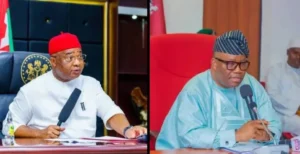
The change is especially significant for figures like the Imo State Governor, Hope Uzodimma, who is expected to run for the Senate in 2027.
The rescinding of the amendment also signals a shift within the ruling All Progressives Congress (APC) towards a more competitive and inclusive process for selecting the next Senate leadership, as against pre-determining it through tenure restrictions.
The Senate had on Wednesday amended its standing rules to restrict eligibility for presiding and principal offices to senators who had served at least two consecutive terms.
The amendment was adopted on Wednesday following a voice vote presided over by Senate President Godswill Akpabio.
The decision came amid speculation that former senators Hope Uzodimma, Ifeanyi Okowa and Ovie Omo-Agege were considering a return to the red chamber and a possible bid for the senate presidency in 2027.
The revised rules stipulated that only senators with at least eight years of continuous service in the chamber could contest for the positions of senate president and deputy senate president.
The amendment followed a closed-door session that lasted about three hours.
The senate also amended orders 4 and 5 to narrow the scope of eligibility for leadership positions in the 11th National Assembly. Order 4 provides that nomination of senators for presiding offices must strictly follow ranking.
The ranking includes the former senate president, former deputy senate president, former principal officers, senators who have served at least one term, former members of the House of Representatives, and first-time senators where others are unavailable.
Order 5 introduces an additional requirement for principal offices. It states that no senator shall be eligible to contest for any principal office unless he has served at least two consecutive terms immediately preceding nomination.
The amendment effectively excludes incoming senators in the 11th National Assembly who were not part of the 9th and 10th senates.
Presiding offices in the senate include President of the Senate and Deputy Senate President.
Principal offices include Senate Leader, Deputy Senate Leader, Chief Whip, Deputy Chief Whip, Minority Leader, Deputy Minority Leader, Minority Whip and Deputy Minority Whip.
The amendment also affects potential aspirants for the 2027 leadership of the senate.
Senator Adams Oshiomhole, representing Edo north, was the lone dissenting voice as the senate adopted the resolutions by voice vote.
Attempts by Oshiomhole to raise a point of order were repeatedly rebuffed by the senate president.
According to Oshiomhole; “This was not what we agreed at the closed-door session,” he insisted as Akpabio read the resolutions.
Before the amendment, any ranking senator — defined as one who had served at least four years — could contest for the presiding offices.
The senate also introduced additional changes to its rules.
Order 8 (1) was amended to fix committee meetings between 3 pm and 6 pm from Monday to Friday, except on the second and fourth Fridays of each month.
Order 8 (2) now provides that plenary sessions shall be held on Tuesdays, Wednesdays and Thursdays from 11 am to 3 pm unless extended by the senate leadership.
Similarly, Section 55 (11) was amended to allow presiding officers and nominees undergoing screening to drink water during the plenary.
Section 66 (8) was revised to require suspended senators to withdraw from the plenary as directed by the senate president, with the duration of suspension to be determined by resolution.
Section 94 (1) stipulates that committees shall have between seven and 25 members.
It also provides that no senator shall serve on more than seven committees, with appointments reflecting the six geopolitical zones.
Section 96 was amended to include oversight of regional development commissions across the six geopolitical zones.