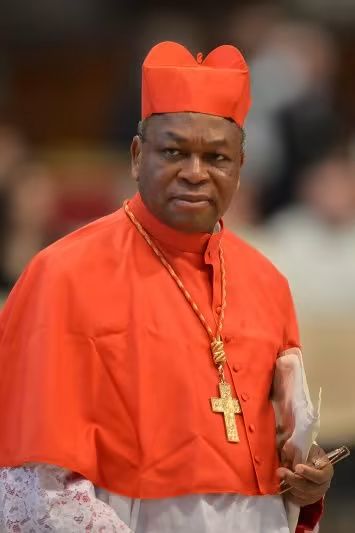
The Presidency on Saturday August 1, 2026 launched a verbal attack on the Catholic Archbishop Emeritus of Abuja, Cardinal John Onaiyekan, saying that he breached confidentiality and “abused clerical privilege”.
It specifically declared that privileged access to the President should not be converted into a platform for public post-meeting commentary.
Cardinal Onaiyekan had during an interview with Arise Television gave details of the meeting between President Bola Ahmed Tinubu and the Catholic Bishops’ Conference of Nigeria (CBCN), saying that the bishops painted a grim picture of Nigeria to the President — citing poverty, hunger, unemployment and insecurity, but only for the President to oppose the bishops’ position and rejected the characterization and insisted that the country was not “bleeding.”
The highly respected Cardinal stated that the bishops met Tinubu in good faith to present the realities millions of Nigerians were facing.
Onaiyekan noted that President Tinubu pushed back during the meeting as he insisted that his economic reforms were already producing results and that the nation was on a recovery path.
Onaiyekan particularly expressed concerns that President Tinubu was being insulated from the true hardship on the ground by aides who present an overly rosy picture.
The Archbishop Emeritus also questioned the independence of the Independent National Electoral Commission (INEC), stressing that public trust in the commission would remain weak so long as its leadership is appointed by the President.
However, the Presidency in its reaction, declared that Onaiyekan’s interview was fundamentally inappropriate as he divulged what transpired at a private meeting between the President and the Catholic Bishops Conference of Nigeria.
A statement by Temitope Ajayi, Senior Special Assistant to the President on Media and Publicity, said Onaiyekan’s interview was an abuse of clerical privilege.
According to Ajayi; “The audience was sought by the bishops and granted by Tinubu in good faith. The President listened patiently and responded to every issue raised. Such high-level engagements are expected to remain confidential”.
The Presidency particularly debunked the notion that Tinubu dismissed the country’s challenges, stressing that President Tinubu acknowledged the economic and security difficulties but disagreed with the bishops’ “bleeding nation” framing. The statement further said that Tinubu argued that Nigeria was “gradually emerging from years of fiscal and economic decline” and that measurable progress had been recorded.
It also said that the Presidency listed what Tinubu cited to the bishops to include; improved fiscal stability, higher revenue allocations to states, more consistent payment of salaries and pensions, and notable gains in security operations across multiple theatres.
On insecurity, the Presidency insisted that Tinubu did not deny the severity of the crisis, but the claim that nothing had improved, adding that the bishops relied on media reports, while the President as Commander-in-Chief receives classified briefings and battlefield intelligence daily, giving him a more complete operational picture.
The Presidency explained that the President is exposed to “competing advice, conflicting intelligence, uncomfortable assessments and hard realities” daily through intelligence reports, economic data, newspapers, and both formal and informal engagements.
According to the Presidency; “What truth does anyone really need to tell President Tinubu that he does not already know?”
The statement stated that while the bishops were within their rights to present moral concerns to the President, Archbishop Emeritus Onaiyeka crossed a line by turning a private discussion into public commentary.
It further stated; “Clerical office carries not only influence but also responsibilities, including discretion, restraint and respect for the confidentiality of high-level discussions”.
The exchange highlights the growing tension between the Tinubu administration and religious leaders over the state of the nation, as economic reforms continue to bite and insecurity persists in parts of the country.
Find below the statement by the Presidency
Cardinal Onaiyekan’s Abuse Of Clerical Privilege
By Temitope Ajayi
There is something fundamentally inappropriate about Cardinal John Onaiyekan granting a television interview to offer his own account and interpretation of what transpired during the private meeting between the Catholic Bishops’ Conference of Nigeria and President Bola Tinubu. It is, in my view, an abuse of clerical privilege.
The bishops requested an audience with the president. He granted the audience graciously. They presented, as was their right, a catalogue of the country’s economic, social, and security challenges as they saw them. Except for their grudging acknowledgement of the benefits of NELFUND, they were dismissive of the other great things done by the administration. The bishops were notably acerbic in their submission, but the president listened to them patiently and responded.
That should ordinarily have been where the matter rested. None of the issues raised by the bishops is beyond scrutiny or rebuttal. Their assessment is neither scripture nor an article of faith. It is a perspective, and perspectives can be challenged with facts and evidence.
President Tinubu did exactly that, responding point by point to the issues they raised. On the bishops’ demand for the return of schools to their owners, the President was surprised that such an issue could be tabled before him, as it is a matter for the states to resolve, in line with our constitution. So, he asked the bishops to take the matter to the governors and reminded them he returned mission schools in Lagos State when he was governor.
The President argued that the bishops’ characterisation of the country’s current condition was incomplete and, in several respects, inaccurate. He pointed to measurable progress on the economic, social, and security fronts. He did not pretend that Nigeria’s problems had disappeared. He acknowledged that significant economic and security challenges remain. His point was that the country has emerged from “a dark tunnel”, that his administration has laid the foundations for recovery and that the next phase is to ensure the greatest number of Nigerians feels the gains.
What the clerics often overlook in these interventions is that governing a country is fundamentally different from shepherding a church. In a democracy, every interest group, including the Catholic Church, has every right to demand more from government. That is part of democratic engagement.
But the president of a nation of more than 200 million people is required to make difficult choices every single day. Those choices involve competing interests, limited resources, and imperfect options. They will inevitably disappoint some constituencies. There is no president, whether Tinubu or whoever succeeds him, who can wave a magic wand and make Nigeria’s accumulated problems disappear overnight.
It is easy to compile a list of national problems. It is far more difficult to acknowledge the disasters that have been averted. Whatever anyone thinks of President Tinubu’s policies, it is impossible to ignore the fiscal crisis he inherited and the measures taken to pull the country away from the edge of a financial cliff. Even the bishops themselves should recognise that one tangible consequence has been the restoration of greater fiscal stability across many states.
Countless civil servants and pensioners who, for years, endured unpaid salaries and pensions are now receiving them more regularly. That was certainly not the reality in many states from around 2014. Even about four years ago, 27 state governments struggled to meet even their most basic obligations. Many of those civil servants and pensioners are themselves parishioners in Catholic churches.
They know, from lived experience rather than official pronouncements, that there has been real relief in the regular payment of salaries and pensions. While this does not erase the discomfort many Nigerians still face, it is wrong to dismiss or ignore those improvements casually.
So when President Tinubu reminded the bishops of these facts during the meeting, he was not, as Cardinal Onaiyekan later suggested, being aloof or dismissive. He was presenting evidence to support his argument that the country is not standing still. A disagreement over facts should not be interpreted as arrogance.
The same applies to security. The bishops declared that Nigeria is bleeding. The President thinks otherwise. President Tinubu did not deny the seriousness of the security situation. Rather, he acknowledged the challenge while outlining the gains recorded by the Armed Forces and intelligence agencies across different theatres of operation.
As Commander-in-Chief, he receives operational briefings, intelligence assessments, and battlefield reports unavailable to the general public. The bishops, like other Nigerians, rely largely on media reports and public information. That does not make the President infallible, but it does mean he possesses information unavailable to the generality of the people. It is, therefore, legitimate for him to argue that the overall picture is more nuanced than newspaper headlines sometimes suggest.
Cardinal Onaiyekan’s Arise News interview also reflected a familiar error that many ideological and professional critics make. They often assume that only critics speak truth to power, while everyone around a leader is either unwilling or incapable of doing so. It is an attractive narrative, but it is rarely true.
What truth does anyone really need to tell President Tinubu that he does not already know? As president, he has multiple channels for feeling the pulse of the country. He reads an average of 10 newspapers every day. He watches television, including discussion programmes, to gauge public opinion. He receives daily security, social, and economic intelligence reports from various arms of government, reports that are prepared for decision-making and are not sugar-coated. In a meeting earlier in the week, he still referenced a very harsh and largely uninformed opinion piece written by Dr. Chidi Amuta in his last Sunday Thisday Newspaper column.
Beyond that, he has friends and associates embedded in the social fabric of the country, drawn from different regions, professions, and political persuasions, who serve as informal sounding boards. Against that background, the suggestion that President Tinubu somehow needs only the Catholic Bishops to acquaint him with the truth is an overreach. They are an important constituency, but they are by no means the exclusive custodians of the national mood or the nation’s conscience.
To assume that criticism delivered publicly is the only form of truth-telling is to misunderstand how government works. Presidents are exposed daily to competing advice, conflicting intelligence, uncomfortable assessments, and hard realities. Presidents are constantly confronted with information, much of it unpleasant. The real question is not whether they know the truth but what choices they make in response to it.
The Catholic Bishops discharged what they considered their moral obligation by presenting their concerns to the president. President Tinubu, for his part, accorded them respect by granting them an audience and responding to every issue they raised. That exchange reflected the civility expected in a constitutional democracy.
Reciprocity should have dictated that the confidentiality and dignity of that engagement be preserved. As such, it was inappropriate for one of the participants to emerge almost immediately on national television to provide his own version of what was essentially a private conversation with the president. Clerical office carries privileges, but it also imposes obligations. Among the qualities the Scriptures require of bishops are temperance, maturity, self-restraint, and the wisdom to remain above needless public controversy. Those virtues become even more important when dealing with matters of state. Public influence should be exercised with discretion, not by converting privileged access into a platform for post-meeting commentary.
-Ajayi is Senior Special Assistant to President Tinubu on Media and Publicity