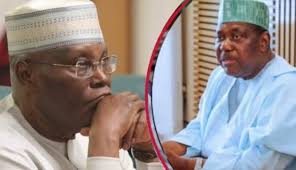
The Secretary to the Government of the Federation (SGF), Senator George Akume, has said that former Vice President Atiku Abubakar was one of the key political figures who proposed and consented to the implementation of a rotational presidency in Nigeria.
Akume, said this was shortly after the annulment of the June 12, 1993, presidential election, adding that the cancellation of the June 12 election compelled political leaders in the country to make strategic choices to ensure national unity and stabilize democracy.
Akume, who stated these in a statement by his spokesperson, Yomi Odunuga, quoting the SGF at a media briefing in Abuja on Tuesday, June 9, 2026, said that chieftains of the Peoples Democratic Party (PDP) gathered in Kaduna under the guidance of the late Chief Solomon Lar and Mallam Adamu Ciroma and exhaustively deliberated on power rotation and the zoning of the presidential ticket.
At the media briefing organized to mark Nigeria’s 27th Democracy Day anniversary, Akume further explained that it was a tough argument before the issue of rotational presidency was resolved and agreed upon.
In the words of Akume; “At the end, we had to concede. We must do this. June 12 annulment had complicated the whole thing. It was finally agreed that we will be alternating between the North and South.
“Atiku was one of the leaders at that meeting, which was convened by Chief Solomon Lar. He was part of that agreement,” he noted.
Akume further said that the arrangement to alternate power between the North and South was designed to ease the political friction caused by the annulment, while fostering a sense of belonging and national unity.
Referencing the events of June 12, Akume characterized the annulment as a distressing obstacle in Nigeria’s democratic history, and stressed that the results of that election truly represented the choice of the citizens.
According to Akume; “Abiola won that election round and square. That election was annulled by the military government. It was very painful because the people spoke and they spoke freely”.
The SGF noted that the ultimate takeaway from June 12 remained the supremacy of the citizens’ choice in a democratic system, emphasising that Nigeria has since fortified its electoral frameworks to forestall a recurrence.
Akume said; “The voice of the people must always be supreme; it must be sacrosanct. That’s the beauty of democracy. We prefer the ballot to bullets”.
While calling on political figures to honour election results and uphold democratic principles, Akume noted that 27 years of continuous civilian governance has demonstrated Nigeria’s dedication to democracy, freedom of expression, and constitutional law.