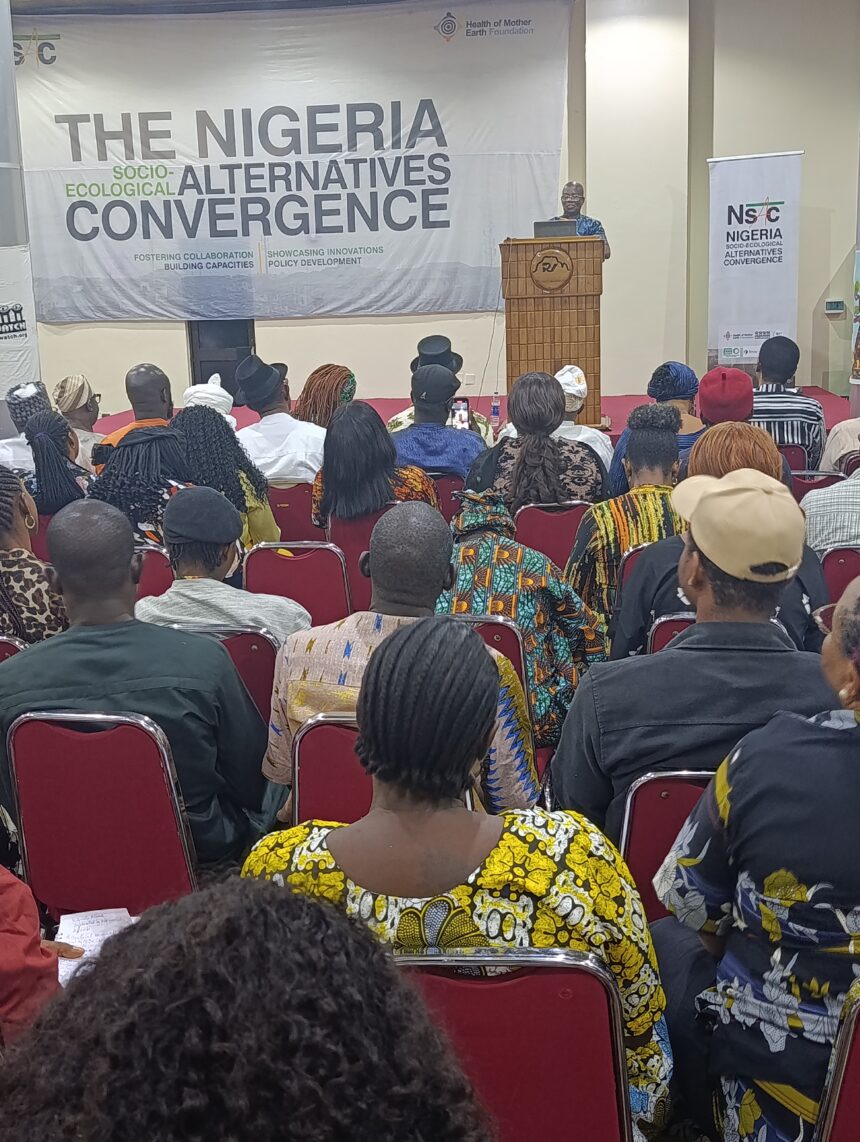
The Third Nigeria Socio-Ecological Alternatives Convergence (NSAC), rose from an international conference in Abuja on Tuesday, July 14, 2026, demanding the strengthening of environmental and mining governance by enforcing existing laws, empowering regulatory institutions, and tackling illegal mining and logging.
It also called for the adoption of a National Just Energy Transition and Critical Minerals Strategy that prioritises ecological security, climate action, renewable energy, environmental protection, industrialisation and community development.
The Convergence which was convened by the Health of Mother Earth Foundation (HOMEF) and partner organisations with the theme “Deforestation, Mining, and the Crisis of Human Security in Nigeria” which attracted participants from some African countries, government representatives, traditional institutions, academics, civil society organisations, labour unions, host and frontline communities, youth and women groups, the media, development partners and environmental justice advocates, noted that while growing global demand for critical minerals presents opportunities for economic growth and industrial transformation, stressed that these must not come at the expense of environmental sustainability, ecological integrity, community rights, human rights, social justice, intergenerational equity or meaningful public participation.
Participants at the convergence stressed that forests, land, water, biodiversity and mineral resources are public ecological assets whose governance must serve the public interest and avoid repeating the environmental and governance failures of decades of oil and gas extraction.
The also emphasised the need to make free, prior and informed consent (FPIC) mandatory for all projects affecting indigenous peoples and host communities and called for the protection of community rights and ecologically sensitive areas by recognising customary land rights, ensuring equitable benefit-sharing, and prohibiting extractive activities in forests, wetlands, biodiversity hotspots, watersheds and other No-Go Zones.
The Convergence also called for the need to promote transparency and accountability through independent ESIAs, restoration bonds, mine closure plans, regular audits, and public disclosure of licences, contracts, beneficial ownership and environmental compliance.
A communique issued at the end of the Convergence demanded for an advance responsible mineral development through domestic value addition, local content, technology transfer, sustainable formalisation of artisanal mining, and a circular mineral economy.
It also called for increase investment in renewable energy, ecological restoration and climate resilience, particularly for underserved communities.
Participants also demanded for the protection of environmental defenders and strengthening of multi-stakeholder collaboration to advance transparency, accountability and ecological justice.
The Convergence also demanded the private sector and development partners to uphold high environmental, social and governance standards, support responsible investment, and respect for community rights.
The communique further stated; “Affirm that Nigeria’s energy transition must be people-centred, rights-based and environmentally sustainable, ensuring community consent, strong environmental safeguards, transparent governance, equitable benefit-sharing and ecological restoration.
“The Third Nigeria Socio-Ecological Alternatives Convergence (NSAC) unanimously reaffirmed that Nigeria stands at a defining moment in its environmental and development trajectory.
“While growing global demand for critical minerals presents opportunities for economic growth and industrial transformation, participants stressed that these must not come at the expense of environmental sustainability, ecological integrity, community rights, human rights, social justice, inter-generational equity or meaningful public participation.
“The Convergence further affirmed that forests, land, water, biodiversity and mineral resources are public ecological assets whose governance must serve the public interest and avoid repeating the environmental and governance failures of decades of oil and gas extraction. Participants committed to strengthening collaboration among government, communities, traditional institutions, civil society, academia, labour and the private sector to advance democratic natural resource governance and sustainable, people-centred development,” it stated.