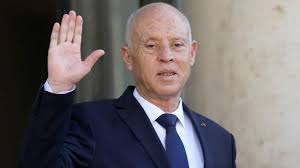
Days after overthrowing the Prime Minister and imposing emergency law in the country, Tunisia’s President, Kais Saied, has sacked senior officials, including prosecutors and judges
Also taking on judicial powers, there are raising fears that Saied is probably setting the stage to undo democratic gains achieved by Arab spring.
His crackdown has dragged the country deeper into uncertainty days after its elected parliament was suspended for a month in a shock move that brought a decade of faltering democracy to a sudden halt.
The actions of Saied, a relative newcomer to politics, have been widely labelled a coup, and there are fears that the North African state could end up with the sort of autocratic regime that ruled it for decades until the Arab spring.
Tunisia, where the revolutions began in 2010, had clung to hard-won democratic gains made during years of economic and political instability.
Their abrupt end, and the muted response from inside the country and around the Middle East, have stunned proponents of the uprising and the transition to democracy.
Saied’s moves followed protests by Tunisians who are fed up with years of economic malaise, made worse by one of Africa’s worst COVID-19 outbreaks, and political paralysis.
Reacting to recent developments in the country, a teacher from Tunis, Suha Rached, said; “This was the last poster child of the Arab spring. I don’t know what to feel now. It’s not even clear if it was worth it.”
Across the country, reactions have been largely low-key. Mohammed Ali, 33, a resident of Ben Guerdane, said he and people he knew were in favour of the takeover. Ali, who spoke on phone, said; “I think what happened is good. I think that’s what all the people want.”
He blasted the country’s biggest party, Ennahda, which he said had failed to improve the lives of the country’s citizens. “Everyone is fed up with them,” he said. “Ennahda help only themselves.”
Ali also said he did not believe true democracy existed anywhere, although he took part in the revolts that resulted in the country’s former dictator Zine al-Abidine Ben Ali fleeing the country in January 2011.
A lawyer in Tunis, Lamia Farhani, was angered by the suspension of parliament. Like many other families, she had a personal stake in the revolution. Police killed her brother, Anis, the day before Ben Ali fled.
Her organisation, the Association of Families of Martyrs and Wounded of the Revolution, compiled details of all those killed and wounded during clashes at the time.
Farhani said she saw this crisis coming. “We called before for all parties to reform. The first step was to stop the humiliation of parliament. We rejoiced for Kais Saied on Sunday,” she said.
Admitting that the method adopted by the President has affected the gains of the revolution, Farhani however said this week’s developments did not mark the end of Tunisia’s experiment with democracy.
According to her; “The Tunisian people will remain in control. The Tunisian people were the first to revolt in the region and inspire the rest of the people.
“The worst democracy in the world remains better than the most just dictator.”