The court proceedings on the trial of six suspects accused of allegedly plotting to overthrow the administration of President Bola Ahmed Tinubu continued with the preview of a recorded video of a statement of the 4th defendant, Zekeri Umoru, an employee in the maintenance department at the Presidential Villa, working with Julius Berger Nigeria.
In the video, Umoru narrated how his contact with individuals later identified as key figures in the coup plot allegation began in May 2025, through the third defendant, Inspector Ahmed Ibrahim attached to the Presidential Clinic.
Umoru told investigators that Ibrahim introduced him to a man named Hassan Mohammed, who he later identified as Colonel Mohammed “Ma’aji,” under the pretext of offering him electrical work at a building under construction.
Umoru said he initially believed Ma’aji was a civilian businessman after receiving money transfers bearing his name.
The witness recounted multiple instances where he received money from Colonel Ma’aji, sometimes in the presence of Ibrahim.
He also described several visits by Ma’aji and another associate, Usman, who he later discovered to be military personnel.
Umoru told the court that during one of the meetings at a location identified as “Tiger Bar,” Ma’aji gave money ranging between ₦100,000 and ₦120,000 to him and his associates after buying drinks and making inquiries about their professions.
A more significant transaction, according to the video, occurred on September 24, 2025, when Ma’aji allegedly handed him a “Ghana Must Go” bag containing cash, adding that he deposited the money at a branch of Zenith Bank, where it was counted as ₦8.8 million.
Umoru further testified that the following day, he and Ibrahim met Ma’aji during which an additional ₦2 million was given, with instructions that Ibrahim would later brief him on further details.
He also told investigators that he later became uncomfortable with the continuous flow of money and pressed Ibrahim for clarification.
Umoru said that Ibrahim claimed that Ma’aji was dissatisfied with the state of the country and was planning to “sanitize the government,” allegedly with the support of unnamed associates described as “boys.”
He also alleged that Ibrahim suggested a plan involving an ambulance driver to facilitate access into the Presidential Villa, with expectations of financial gain.
Umoru however, said in the video that he was unaware of any concrete plan and insisted he never knowingly participated in any plot.
He described an incident where he escorted Usman into the Presidential Villa, saying that security personnel at the gate did not question them after he indicated that the visitor was there to see him.
Umoru said he later found Usman taking photographs in his office and warned him against such actions.
Throughout the recorded interview, Umoru denied knowledge of any coup plot, insisting that he was misled by Ibrahim, emphasising that he would have distanced himself from Ma’aji had he known he was a military officer or had any intention beyond business dealings.
Umoru also expressed regret, apologizing to his employers and affirming his support for President Tinubu’s administration.
The court also viewed a separate video involving an Islamic cleric, Sheikh Imam Kassim Goni, who said he relocated to Karu in Abuja after fleeing insurgency in Maiduguri.
Goni, who denied any involvement in the coup plot, told investigators that he received funds from Colonel Maaji strictly for prayers and charitable purposes, including requests for spiritual intervention following alleged setbacks in promotion, adding that all cash received were tied to religious activities, not political or military objectives.
However, investigators in the video pointed out discrepancies between his claims and financial records, indicating that funds had been transferred to him as early as March 2023, months before the alleged promotion issues he referenced.
Additional records further showed transactions running into millions of naira, including a ₦10 million transfer in October 2024.
The prosecution suggested that discussions referenced in the videos, including remarks about gaining access and acquiring “work tools,” raised concerns about a broader scheme, though both individuals denied any knowledge of a coup plot.
Following the preview of the video, the DPP, Rotimi Oyedepo SAN, informed that the recording of the 6th defendant was in a different device and he had given it to counsel to the sixth defendant, Michael Numa, SAN.
Responding, Numa, SAN, told the court that he just received the video exhibits of his client, adding that he needs time to go through the exhibit.
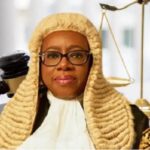
Justice Joyce Abdulmalik subsequently adjourned the matter to May 11, 12 and 13 for continuation of trial.